
UNDERSTANDING YOUR FELINE COMPANION
Lucia Fernandes, Feline Behavior and Environmental Enrichment Specialist (CoE, Oplex Certified)


Environmental Enrichment for Indoor Cats: The Complete Guide
By Lucia Fernandes, Feline Behavior & Environmental Enrichment Specialist (CoE, Oplex Certified)| Updated July 2026 | 16 min read
QUICK ANSWER
Environmental enrichment is the practice of designing a cat's home around five core needs identified in the AAFP and ISFM Feline Environmental Needs Guidelines: a safe elevated retreat, multiple separated resources, daily predatory-style play, predictable human interaction, and a sensory environment that respects a cat's sense of smell. Cats denied of these needs often develop stress-related behaviors such as scratching, litter box avoidance, or aggression, not out of misbehavior, but because the environment is not meeting them. Addressing all five areas, rather than adding a single toy or cat tree, is what actually changes behavior long term.
A client called me a few years ago convinced her cat hated her. Every night, the same routine: the sofa, shredded corner by corner, no matter what she tried.
She wasn't neglecting him. She'd read the articles. Bought the sprays, the covers, three different scratching posts. Nothing worked. He kept scratching. Kept pacing at 3am. Kept staring at her like she was missing something obvious.
She was.
His home was safe. It just wasn't enough. That gap, between a home that is safe and a home that actually meets a cat's needs, is what most people are really describing when they talk about indoor cat boredom, and it tends to stay invisible until it turns into a behavior nobody wants to live with.
In my practice, environmental enrichment is the first thing I check. Before medication. Before training. Before assuming a cat is simply being difficult. Because most of the time, the cat isn't being difficult at all. It's communicating, and the message is almost always about space, not spite.
This page is organized around the same framework I use in an actual assessment. If your cat is already showing one specific problem, such as scratching furniture or avoiding the litter box, those pages go deeper into that single behavior. This one is the foundation underneath all of them.
Signs of a Bored Indoor Cat, and What They Actually Mean
Cats rarely announce boredom the way a restless child might. Instead, indoor cat boredom tends to surface as a behavior the owner reads as naughtiness, illness, or "just their personality." Here are six of the clearest signs of a bored indoor cat, translated into what your cat may actually be communicating.
A cat who scratches the sofa instead of the post you bought is not being defiant. In practice, the post is almost always too short, too wobbly, or the wrong texture for a full stretch. See Scratching Behavior for the full fix. A cat who pees outside a box that looks perfectly clean is rarely making a hygiene complaint. That pattern points to stress or resource competition far more often than dirt, which is exactly why Why Cats Avoid the Litter Box works through six separate causes instead of one. Ankle-stalking at 6am is predatory energy with nowhere structured to go, and it responds well to the kind of play described in Play as Enrichment.
A cat who disappears under the bed for most of the day is usually telling you there's no elevated or enclosed retreat that feels safe out in the open, so the space under the bed becomes the only option left. Bald patches from overgrooming are a common stress outlet when the environment is understimulating or unpredictable, covered in more depth on Anxiety in Cats. And sudden aggression toward a housemate cat is frequently about resource competition or a lack of vertical territory rather than a personality clash, which Aggression in Cats walks through in full. If more than one of these six sounds familiar, that's normal, unmet needs rarely show up one at a time.

Cats avoid scratching posts that feel unstable. If a post wobbles or tips, they won’t trust it, so the sofa becomes the safer, more satisfying option.
A QUESTION I GET CONSTANTLY
Is my cat bored, or actually stressed?
Boredom tends to show up as destructive or attention-seeking behavior, scratching, knocking things over, pestering you for play. Stress tends to show up as withdrawal, overgrooming, or changes to eating and litter box habits. The two overlap constantly, and an under-stimulated cat left unaddressed usually becomes a stressed one. See Anxiety in Cats if withdrawal or overgrooming is the main pattern you're seeing.
The Five Pillars of a Healthy Feline Environment
In 2013, a joint expert panel convened by the American Association of Feline Practitioners and the International Society of Feline Medicine published guidelines built around five environmental needs shared by every domestic cat, regardless of breed, age, or living situation. This is the same framework I use when assessing a case, and it is the structure for the six sections below.
FIVE PILLARS OF A HEALTHY FELINE ENVIRONMENT
A framework from feline veterinary specialists describing five needs every indoor cat requires: safety, resources, play, human interaction, and a scent environment they control. The six sections below map onto these five pillars, with vertical territory and life-stage adaptation given their own space because of how often they come up in practice.
Why Environmental Enrichment Changes Behavior
Enrichment doesn't work because a cat gets tired. It doesn't work because they get distracted from the sofa, the doorway, or the box. It works because the need behind the behavior is finally being met.
This is the idea underneath almost everything on this site. Cats don't perform behaviors because they want to create problems. They perform behaviors because they are trying to meet needs, and scratching, marking, hiding, and pacing are simply the tools available to them for doing that. Once you start reading behavior this way, most of what looks confusing about a cat starts making sense.
A cat doesn't need a perfect home. It needs a home that lets it be a cat
If you've ever looked at your cat and wondered, "why are you doing this," there's a good chance your cat has been asking exactly the same thing about your home. The six reasons below are what closing that gap actually looks like, room by room.
1
A Safe Place, Preferably Up High
This is usually where I start an assessment, because if a cat doesn't feel safe, nothing else on this list matters yet.
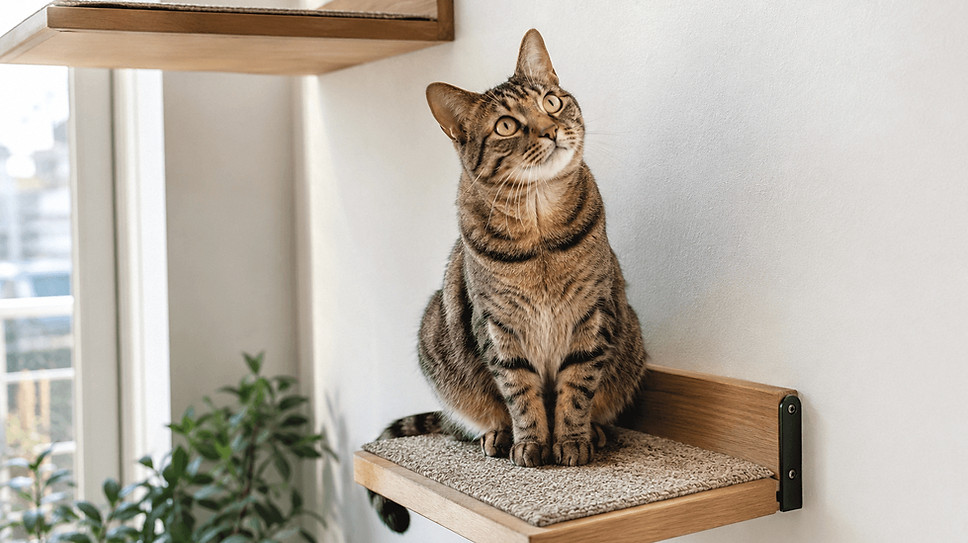
We often think shelves and cat trees are little luxuries. Your cat doesn't see it that way. To a cat, height means safety, and a cat with no access to elevation, and no enclosed space to disappear into, is a cat living in a near-constant, low-grade state of vigilance.
I see this mistake surprisingly often. Someone buys a beautiful cat tree. The first time the cat jumps on it, it wobbles. They never use it again. What actually works is height that feels rooted: wall-mounted shelves anchored into a stud, a tall tree with a wide base, or a windowsill perch built to hold full weight without flexing.
VERTICAL TERRITORY
The three-dimensional space a cat can use, not just the floor area of a room. Shelves, cat trees, windowsills, and the tops of furniture all count. Cats use vertical territory to avoid conflict in multi-cat homes and to self-regulate stress by choosing when to be visible.
RESEARCH: A review of housing requirements for cats in the home found that access to elevated resting places and hiding areas is one of the clearest predictors of lower stress in indoor cats, particularly in multi-cat households where height allows conflict avoidance without confrontation. Rochlitz, I. (2005). A review of the housing requirements of domestic cats kept in the home. Applied Animal Behaviour Science, 93(1-2), 97-109.
WHAT TO DO
-
Anchor at least one shelf or tree into a wall stud so it cannot wobble under full weight.
-
Give every cat in the home at least one enclosed hiding spot at floor level and one elevated one.
-
Place a perch at a window with visible outdoor activity, ideally one that fully supports the cat's weight.
-
In multi-cat homes, add height in more than one room so cats are not funneled past each other to reach it.

Cats don't seek height because they enjoy being above us. They seek it because elevation gives them control, security, and the freedom to choose when to engage with the world around them.
2
Resources That Are Multiplied and Separated
Food, water, litter boxes, scratching surfaces, and resting spots are all resources a cat can end up guarding or avoiding if there aren't enough of them, or if they're all clustered in one place. This is one of the most common enrichment gaps I see in multi-cat homes, and it's also one of the easiest to fix once it's identified, because it usually just requires spreading things out rather than buying anything new.
One of the biggest misconceptions I see is that more resources means more clutter. In practice, it almost always means less conflict.
THE N+1 RULE
A guideline for key resources, most often litter boxes: provide one per cat, plus one extra, placed in separate locations rather than side by side. Two boxes next to each other function as one resource from a cat's perspective, since a single confident cat can still block access to both.
The same logic applies beyond the litter box. Food and water bowls placed together can let one cat control access to both. A single scratching post in a busy hallway may be avoided by a nervous cat entirely, even if it is the right height and texture, simply because of where it sits.
WHAT TO DO
-
Apply the N+1 rule to litter boxes, food stations, and water bowls in multi-cat homes.
-
Physically separate resources into different rooms, not just different corners of the same room.
-
Add at least one scratching surface in a low-traffic area, not only near the main entrance.
-
Watch for one cat consistently blocking access to a resource, that's a sign it needs to be duplicated elsewhere.
A QUESTION I GET CONSTANTLY
Why did this behavior start now, out of nowhere?
It rarely is out of nowhere. A new cat, a move, a rearranged living room, or even a new piece of furniture can shift which resources feel accessible and safe. The behavior is often the first visible sign of a change that happened days or weeks earlier, not a sudden personality shift.

Duplicating resources is only half the solution. Placing them in different locations gives cats genuine choice and prevents one confident cat from controlling access to everything.
3
Play and the Predatory Sequence
Play is not entertainment for a cat, it's psychological maintenance. When a cat engages with a wand toy or a moving object, they are rehearsing a full behavioral sequence built into their species: stalk, chase, pounce, bite, and a settling period afterward. Interrupting that sequence partway, which is what happens with most passive toys left on the floor, can leave a cat wound up rather than satisfied.
This surprises almost every family I work with: five real minutes of structured play does more to settle a cat than an hour of toys scattered across the floor. It's one of the simplest indoor cat activities you can add today, and also the one most often done halfway.
THE PREDATORY SEQUENCE
The fixed order of behaviors a cat performs during hunting: stalking, chasing, pouncing, and biting or "killing" the toy. A play session that lets a cat complete all four stages produces a calmer, more settled cat afterward than one that stops at chasing alone.
RESEARCH: In a survey of 277 cat owners, cats who received play sessions of five minutes or longer had fewer reported behavior problems, including aggression toward people and other cats, than cats whose play sessions lasted a minute or less. The number of toys owned mattered less than actual daily engagement. Strickler, B.L., & Shull, E.A. (2014). An owner survey of toys, activities, and behavior problems in indoor cats. Journal of Veterinary Behavior, 9(5), 207-214.
WHAT TO DO
-
Use a wand toy that moves like prey, not a static toy left on the floor.
-
Let the cat catch and "kill" the toy at the end of every session, don't stop at the chase.
-
Aim for two sessions a day of 10-15 minutes, timed near dawn and dusk when cats are naturally most active.
-
Follow play with a small meal or treat, mimicking the natural hunt-then-eat sequence.
-
elsewhere.

The goal isn't to tire your cat out. It's to let them complete the full hunting sequence, (stalk, chase, pounce, and bite) so a natural behavioral need is fully satisfied.
Play isn't entertainment. It's psychological maintenance
THE BIGGEST MISTAKE I SEE
People assume enrichment means buying more things. Most of the time, it means rearranging the things they already have.
A QUESTION I GET CONSTANTLY
Why does my cat ignore the expensive toys I bought?
Usually because the object itself was never really the point. Most cats care more about how a toy moves, and who is on the other end of it, than what it cost. This is also why interaction from you tends to outperform objects on their own, which is exactly what the next section is about.
4
Predictable, Cat-Initiated Human Interaction
Human contact is itself a form of enrichment, but only when it happens on terms the cat can predict and control. Interaction forced on a cat, cornering them for affection or picking them up when they haven't asked for it, tends to produce the opposite of the intended effect. What actually builds trust is consistency: interaction that starts when the cat approaches, and stops when they move away.
This is one of the parts of enrichment I have to explain most often, because it runs against instinct. Less forced affection usually means a closer bond, not a more distant one.
RESEARCH: In a formal preference test comparing social interaction, food, toys, and scent, most cats in both pet and shelter populations chose human social interaction over the other three categories, more often than commonly assumed. The finding challenges the idea that cats are indifferent to people and suggests interaction quality, not just presence, drives the benefit. Vitale Shreve, K.R., Mehrkam, L.R., & Udell, M.A.R. (2017). Social interaction, food, scent or toys? A formal assessment of domestic pet and shelter cat preferences. Behavioural Processes, 141(3), 322-328.
WHAT TO DO
-
Let the cat initiate contact rather than approaching them for affection.
-
Keep handling brief and end it before the cat shows signs of wanting to leave.
-
Build a predictable daily routine around feeding, play, and quiet time, cats regulate stress through predictability.
-
Avoid picking up a cat who is retreating or hiding, that removes their control over the interaction.
5
Respecting the Nose: Scent and Sensory Enrichment
Imagine walking into your home tomorrow and everything smelled like strangers. That's roughly what a heavy-handed cleaning day, brand new furniture, or another cat's scent can feel like to your cat, who probably notices a change in smell long before you notice anything different at all.
Cats navigate and reassure themselves through scent far more than sight. They rub their faces against furniture and doorways to deposit their own scent, effectively marking the home as familiar and safe. Strong cleaning products, new furniture, or another cat's scent introduced too quickly can disrupt that sense of familiarity and register as a low-level threat.
FACIAL MARKING (Bunting)
The behavior of a cat rubbing their cheek or chin against objects and people to deposit scent from glands on the face. This is a self-soothing behavior as much as a communicative one, and a home that carries a cat's own scent tends to feel more secure to them.
Beyond scent, cats also respond to light, sound, and visual motion. A window seat overlooking outdoor activity offers a rotating source of stimulation that costs nothing and requires no supervision. Rotating a small number of toys, rather than leaving all of them out permanently, keeps novelty alive without adding clutter. This is a detail most people never think to check, and it's often the missing piece when nothing else explains a cat's unease.
WHAT TO DO
-
Avoid heavily scented cleaning products on surfaces a cat rubs against or rests on.
-
Give a new item, piece of furniture, or a new cat's bedding time near existing scented objects before full introduction.
-
Rotate two or three toys out of a larger set weekly instead of leaving everything out at once.
-
Provide at least one window perch with a view of outdoor movement.

A window offers far more than a view. Birds, changing light, outdoor sounds, and drifting scents provide constantly changing sensory enrichment that keeps indoor cats mentally engaged without adding a single new toy.
A QUESTION I GET CONSTANTLY
Can a small apartment really be enough?
Yes, and often more easily than a large house where resources end up scattered too far apart. Size matters far less than whether all five pillars are covered somewhere in the home.
6
Adapting Enrichment by Home and Life Stage
You don't need a bigger home to enrich your cat's life. One of the smallest apartments I've worked in had one of the happiest indoor cats I've ever met, because every one of the five pillars was covered in barely more space than a single room.
The pillars stay the same, but how you meet them changes with the home and the cat. A studio apartment cannot fit a floor-to-ceiling cat tree in every room, but a single wall-mounted shelf circuit can provide the same vertical territory in a fraction of the footprint. Enrichment scales down in size well before it scales down in effectiveness, as long as each pillar is still addressed somewhere.
In multi-cat households, resource duplication and vertical space matter more than in single-cat homes, since most conflict in these homes traces back to competition for the same limited resource. A cat who has never had to compete for a sunny windowsill has less reason to threaten a housemate over one.
Senior cats need enrichment adapted rather than removed. Ramps or low steps up to a favorite perch preserve access to height for a cat who can no longer jump as high, and shorter, more frequent play sessions respect joint stiffness while still completing the predatory sequence. For the litter box specific version of this, see Senior Cat Litter Box Problems.
This is the section families skip most often, usually because nothing looks urgent yet. It's also the easiest one to adjust while that's still true.
WHAT TO DO
-
Small apartments: prioritize vertical shelving circuits over floor-based cat trees.
-
Multi-cat homes: duplicate every key resource and add height in more than one room.
-
Senior cats: add ramps or steps to existing perches rather than removing access to height.
-
Any home: reassess enrichment every few months, needs shift as a cat ages or the household changes
Real Case Study
Luna: When "She Loves Destroying Sofas" Wasn't True
Luna's owner, Michelle, believed her cat simply loved destroying sofas. She'd already tried a scratching post that wobbled the moment Luna touched it, double-sided tape, and citrus spray. Nothing worked, and by the time I was contacted, the sofa had already been replaced once.
The sofa was never the real problem. Luna had no stable height to claim as her own, no hunt she was ever allowed to finish, and long stretches of the day alone while Michelle worked and her kids were at school. Her world was small, predictable, and flat, and the scratching was the only language available to her for saying so.
When her environment changed, when she was given a tall stable scratching post, a cat tree, wall-mounted climbing panels, and daily play that let her finish what she started, the scratching didn't taper off gradually. It stopped. Not because she'd been trained out of it, but because she no longer needed it.
★★★★★
"I spent weeks trying to protect the sofa. Tape, sprays, a scratching post she looked at once and never touched again. Nothing worked. When Lucia explained that Luna wasn't being destructive, she was just trying to do what her body needed in the only place that actually worked, everything clicked. Within a few days the sofa was completely forgotten. Luna is a different cat."
Michelle R., Luna's guardian
Is Your Cat's Environment Actually Enriching?
Before you go through the interactive checklist below, here is what it actually checks for. Each of the eight items maps onto one of the five pillars, so the fastest way to read your results is by pattern rather than by individual line. If most of what you leave unticked is about height, hiding spots, or a scratching surface that feels stable, the gap is almost always the safe place pillar. If it's mostly about food, water, and litter box placement, that points to resources. And if it's rotation, window access, or play, the gap usually sits in sensory enrichment or the hunting cycle.
A few of the actual questions, so you know what you're checking for: whether there is stable vertical space in more than one room, whether litter boxes, food, and water are separated following the N+1 rule, whether your cat is the one initiating contact rather than always being picked up, and whether toys get rotated instead of sitting out permanently until none of them get touched. None of this requires spending money. Most of it is rearranging what you already own. Tick everything that's already true in your home, and treat anything left unticked as a real gap worth addressing, not a minor detail.
Where to Start This Week: Simple Indoor Cat Enrichment Ideas
Here is that same five-step sequence in plain terms. Start by watching your cat for two or three days before buying anything, noting where they linger, what they scratch, and when they seem most restless, since that tells you which pillar is weakest before you spend money on the wrong fix. From there, add one stable elevated retreat. A single wall-mounted shelf or a sturdy window perch usually addresses the safe place pillar faster than anything else on this list. If litter boxes, food, or water are grouped together, separate one of them into a different room this week and watch whether use patterns change.
Then move into play and scent. Book two real play sessions daily, ten to fifteen minutes each, timed near dawn and dusk, using a toy that lets your cat finish the full stalk-chase-pounce-bite sequence described in Play as Enrichment. Finish the week by introducing one new scent or hiding spot. A cardboard box, a rotated toy, or a blanket in a new location adds novelty without overhauling the whole home at once. None of these five steps need to happen on the same day. Spread across a week, they cover all five pillars without overwhelming your cat, or you.
Environmental Enrichment vs. Just Buying More Toys
Almost every family I work with has, at some point, bought a small mountain of toys convinced that's what enrichment means. Most of those toys end up untouched in a basket by the door, while the behavior they were supposed to fix keeps happening anyway. Here's the myth behind that basket, and what actually works instead.
The biggest one: more toys means more stimulation. In practice, one real play session beats ten toys scattered across the floor. A cat tree does not fix boredom by itself either, it only helps once it is genuinely stable and the other resources, food, water, the litter box, are spread out too. Price barely matters to a cat. Movement, and whether a person is on the other end of the toy, count for far more than what something cost.
And when a cat seems to have "too much energy," that is usually trapped energy with nowhere to go, not an excess of it. This is exactly why buying yet another toy so rarely works. Rearranging what is already sitting in the home almost always beats bringing in something new.
One Last Thought
Something I tell almost every family I work with is this. If your cat is telling you something through behavior, the question isn't "how do I stop it." The question is "what need is my cat trying to meet."Because once you can answer that, the behavior usually stops being confusing. It starts making sense. And once it makes sense, it becomes something you can actually fix.
Key Takeways
-
Environmental enrichment is built on five needs: a safe elevated place, multiplied and separated resources, daily predatory play, predictable human interaction, and a scent environment the cat controls.
-
Height functions as emotional security for cats, not decoration, and must be stable to be trusted.
-
The N+1 rule (one resource per cat, plus one, in separate locations) prevents resource guarding before it starts.
-
Play should complete the full predatory sequence: stalk, chase, pounce, and bite, not stop at the chase.
-
Human interaction is most effective when the cat initiates it and can end it on their own terms.
-
Scent stability matters as much as visual stimulation, strong cleaning products and abrupt new scents can register as low-level threats.
-
Enrichment needs change with the home and the cat's age, but the five underlying pillars stay the same.
If you've made it this far, you already know play is not entertainment, it's how your cat processes half of what she can't say out loud. But knowing your cat needs to stalk, chase, and finish the hunt is different from knowing how to actually run that fifteen minutes so it works. That gap is exactly what I wrote The Advanced Play Handbook to close.
Most people get stuck at the same point: waving a wand toy around and wondering why the cat still seems restless afterward. Successful play ends with capture, not chaos, and the part almost nobody gets right is the last ten seconds, not the first ten. The book walks through that ending, along with the pacing, timing, and specific movements that turn a toy into something a cat actually needs to catch.If you'd rather stop guessing how to play with your cat and get it right from the first session, join the Early Access List below. It's free, and it comes with launch updates and bonus content you won't find anywhere else on the site.

When General Advice Isn't Enough
Most enrichment problems have more than one contributing cause, and the right fix depends on your cat's specific age, history, and home layout. If you've read through this and still aren't sure which pillar is missing, or you've made changes without seeing results, that's usually a sign the situation needs a closer look.
NEED DIRECT SUPPORT?
Every cat and every situation is different. I don't do generic advice. I look at what is actually happening with your cat and build a plan around that specific case.
If you would like personalised guidance based on your cat's specific behavior, history, and environment, find out how we can work together.
Explore This Topic Further
Luna's Case Study - How a stable scratching post, a cat tree, and daily play stopped months of sofa-shredding.
Play as Enrichment - A closer look at structuring the predatory sequence into daily play.
Routine Building - why predictability itself functions as enrichment.
Safe Home Setup - room-by-room safety alongside enrichment planning.
Frequently Asked Questions
Is environmental enrichment really necessary for cats kept entirely indoors?
Yes. Indoor cats rely entirely on their home to meet needs like hunting, climbing, and territory control that outdoor cats meet on their own. Without enrichment, many indoor cats develop stress-related behaviors such as scratching, litter box avoidance, or withdrawal, not because they are poorly behaved, but because the environment isn't giving them an outlet.
Can environmental enrichment actually reduce or stop behavior problems?
In most cases, yes. Enrichment doesn't suppress a behavior, it removes the reason for it. Cats who scratch, mark, or act aggressively due to an understimulating environment often improve significantly once the specific missing pillar, whether that's height, play, or resource separation, is addressed directly.
My cat sleeps most of the day. Does she still need enrichment?
Usually yes. Excessive sleeping in an otherwise healthy cat is often a sign of under-stimulation rather than contentment. A well-enriched cat still sleeps a great deal, cats are naturally built for long rest periods, but they also show bursts of active, engaged behavior around play and exploration that a bored cat often lacks.
How do I enrich a small apartment without much floor space?
Small spaces can be deeply enriching when the enrichment goes vertical. Wall-mounted shelves, a tall narrow cat tree, and a window perch add usable territory without requiring floor area. Rotating a small set of toys and introducing new scents or hiding spots keeps novelty alive. Square footage matters far less than how intentionally the space is used.
How much enrichment does a cat need each day?
The general recommendation is two structured play sessions of 10-15 minutes daily, ideally timed around dawn and dusk. Beyond play, passive enrichment such as window access, safe hiding spots, and stable scratching surfaces should be available at all times. For cats already showing stress behaviors, increasing play frequency is often the single most effective first step.
Do I need to buy an expensive cat tree, or are shelves enough?
Shelves are enough, and in some homes they work better than a floor-standing tree because they can be placed exactly where a cat already wants to be, such as near a window. What matters is stability, not price: a shelf that wobbles will be avoided regardless of how much it cost.
My cat has plenty of toys and still scratches the furniture. What am I missing?
Toys address only one of the five pillars. Scratching that continues despite toys is usually about the scratching surface itself (too short, too soft, or badly placed) rather than a lack of general stimulation. See Scratching Behavior for the specific fix, since toy quantity rarely solves a scratching-surface problem.
Does environmental enrichment help with litter box problems?
Yes, particularly when the underlying cause is stress or resource competition rather than a medical issue. Reducing overall environmental stress through the five pillars, especially resource separation and safe retreats, often resolves litter box avoidance that persists after ruling out medical causes. See Why Cats Avoid the Litter Box for the full diagnostic picture.
How is enrichment different in a multi-cat household?
Resource duplication and vertical territory matter far more with multiple cats, since most conflict in these homes traces back to competition over a shared resource rather than genuine incompatibility. Applying the N+1 rule to litter boxes, food, and resting spots, and spreading height across more than one room, prevents the low-level tension that often escalates into open aggression. See Multi-Cat Households for the full picture.
Does a senior cat need different enrichment than a younger cat?
Yes. The same five pillars apply, but access needs adapting. Ramps or low steps preserve access to favorite perches for a cat who can no longer jump as high, and shorter, more frequent play sessions respect joint stiffness while still completing the predatory sequence. Enrichment should be adapted for a senior cat, not removed. See Senior Cat Litter Box Problems for how this plays out with the litter box specifically.
What is the fastest way to know if my cat's environment is the problem?
Run through the diagnostic checklist above. Most cats showing stress-related behavior are missing more than one pillar at once, most commonly stable vertical space and a completed play routine. If several boxes go unticked, start there before assuming the issue is medical or purely behavioral.
Can too much enrichment overstimulate a cat?
It's uncommon, but possible, particularly with constant novelty and no quiet retreat available. The fix isn't less enrichment, it's balance: a cat needs a genuinely quiet, undisturbed space to retreat to just as much as they need stimulation, which is why a safe hiding spot is its own pillar rather than an afterthought.
How often should I rotate toys?
Weekly rotation of two or three toys out of a larger set tends to keep novelty alive without requiring constant new purchases. Leaving every toy out permanently is one of the most common reasons cats stop engaging with any of them, novelty is doing more work than the toy itself.
Is window access alone enough sensory enrichment?
It's a strong start but not the whole picture. A window addresses sight, sound, and some scent stimulation, but it doesn't replace the need for safe scent-marking surfaces, stable height, or structured play. Treat window access as one input among the five pillars, not a substitute for the others.
My cat hides under the bed most of the day and won't come out. Where do I start?
Start by giving her an alternative hiding spot that feels just as safe but is closer to daily activity, an enclosed box on a shelf works well, since it offers both concealment and height. Forcing interaction usually backfires. Let her choose to use the new space at her own pace, and keep the household routine as predictable as possible in the meantime. If the hiding has been going on for weeks rather than days, see Anxiety in Cats to rule out a deeper stress trigger.
I've tried adding a cat tree and toys and nothing changed. What am I missing?
This is the most common message I get, and it almost always means one or two of the five pillars were addressed while the others were left untouched. Run through the checklist above section by section rather than assuming the whole environment is covered because one part of it improved. If you're still stuck after that, my free Cat Behavior Report can help pinpoint the specific gap for your cat.
References
-
Ellis, S.L.H., Rodan, I., Carney, H.C., Heath, S., Rochlitz, I., Shearburn, L.D., Sundahl, E., & Westropp, J.L. (2013). AAFP and ISFM Feline Environmental Needs Guidelines. Journal of Feline Medicine and Surgery, 15(3), 219-230.
-
Rochlitz, I. (2005). A review of the housing requirements of domestic cats (Felis silvestris catus) kept in the home. Applied Animal Behaviour Science, 93(1-2), 97-109.
-
Kry, K., & Casey, R. (2007). The effect of hiding enrichment on stress levels and behaviour of domestic cats (Felis sylvestris catus) in a shelter setting and the implications for adoption potential. Animal Welfare, 16(3), 375-383.
-
Delgado, M., & Hecht, J. (2019). A review of the development and functions of cat play, with future research considerations. Applied Animal Behaviour Science, 214, 1-17.
-
Strickler, B.L., & Shull, E.A. (2014). An owner survey of toys, activities, and behavior problems in indoor cats. Journal of Veterinary Behavior, 9(5), 207-214.
-
Vitale Shreve, K.R., Mehrkam, L.R., & Udell, M.A.R. (2017). Social interaction, food, scent or toys? A formal assessment of domestic pet and shelter cat (Felis silvestris catus) preferences. Behavioural Processes, 141(3), 322-328.
-
Herron, M.E., & Buffington, C.A.T. (2010). Environmental enrichment for indoor cats. Compendium on Continuing Education for Veterinarians, 32(12), E1-E5. PMID: 21882164.