
UNDERSTANDING YOUR FELINE COMPANION
Lucia Fernandes, Feline Behavior and Environmental Enrichment Specialist (CoE, Oplex Certified)


Toys for Cats
How the Right Toys Support Emotional Balance, Reduce Stress, and Prevent Behavior Challenges
Toys for cats are often discussed as entertainment. In reality, they play a much deeper role in emotional regulation, stress management, and behavior prevention. When chosen and used thoughtfully, toys support a cat’s natural needs and reduce the likelihood of frustration-driven behaviors.
Toys Are Not Just Entertainment
Many cat guardians buy toys hoping to keep their cat busy, entertained, or out of trouble. When that doesn’t work, it’s easy to assume the cat is uninterested, lazy, or “just difficult.”
In reality, toys are not neutral objects. They can either support emotional regulation or increase frustration.
This page reframes toys not as distractions, but as tools. When chosen and used thoughtfully, toys help cats express natural behaviors, release tension, and feel more in control of their environment. When mismatched or misused, they often contribute to overstimulation, boredom, or stress-related behaviors.
Why Toys Matter for Emotional Well-Being
Play is a core feline need, but not all play meets that need in the same way.
For cats, play is closely linked to:
• hunting behavior
• stress release
• emotional regulation
• confidence and predictability
When these needs aren’t met through appropriate play opportunities, cats often seek alternatives, sometimes through behaviors guardians find concerning, such as biting, scratching furniture, or nighttime activity.
Toys can either help meet these needs proactively or leave them unmet despite good intentions.
Toys and Behavior: Understanding the Connection
Many common behavior challenges are not signs of disobedience. They are signs of unspent energy, frustration, or emotional overload.
Toys play a key role in:
•preventing play-related aggression
•reducing tension in multi-cat households
•supporting redirection away from unsafe behaviors
•increasing a cat’s sense of control and choice
This is why toys are closely linked to strategies discussed in Redirecting Techniques and Play as Enrichment.
Not All Toys Serve the Same Purpose
One of the biggest gaps in online advice is treating all toys as interchangeable. In reality, different toys serve very different emotional and behavioral functions.
Interactive Toys (Human–Cat Play)
Wand toys and interactive play tools allow cats to express full hunting sequences in a safe, controlled way.
These toys are especially helpful for:
• reducing play aggression
• releasing built-up energy
• strengthening the human–cat bond
Structured, predictable play sessions using interactive toys are often the first step in successful redirection. Play as Enrichment)
Independent Toys (Solo Play)
Solo toys can provide mental stimulation and novelty, but they rarely replace interactive play. Some cats enjoy them briefly; others ignore them altogether.
Independent toys work best when:
• rotated regularly
• paired with environmental enrichment
• not relied on as the sole source of stimulation
Expecting solo toys to “fix” behavior issues often leads to disappointment.

Interactive toys support full hunting sequences and emotional regulation through guided play, while independent toys offer brief novelty but rarely replace human–cat interaction.
Puzzle Toys and Food-Based Enrichment
Puzzle toys can support mental engagement and slow feeding, but they are not suitable for every cat or every situation.
For some cats, puzzles:
-
reduce boredom
-
increase confidence
For others, they:
-
increase frustration
-
elevate stress
Understanding a cat’s tolerance for challenge is essential. Puzzle toys should never feel like obstacles to basic needs or sources of daily pressure.
When Toys and Furniture Create Frustration Instead of Relief
Many products marketed as toys or enrichment fail to meet a cat’s physical and emotional needs especially when it comes to scratching behavior.
Scratching is not only about claw maintenance or marking. It is deeply connected to full-body stretching, particularly after rest or sleep. When cats wake up, they instinctively seek surfaces that allow them to stretch their spine, shoulders, and legs completely while feeling stable and supported.
Furniture such as sofas often meet these criteria:
-
adequate height for a full stretch
-
solid, heavy structures that do not move
-
resistance that supports powerful scratching movements
In contrast, many commercial scratching posts are:
-
too short for full extension
-
too light or unstable
-
unable to withstand a cat’s weight and force
Some cats stop using scratching posts not because they dislike scratching, but because the structure feels unsafe, shifts under pressure, or collapses during use.
When this happens, scratching behavior doesn’t disappear it shifts to surfaces that feel more secure. This is frequently misinterpreted as stubbornness or preference, when it is actually a matter of safety, body mechanics, and trust in the environment.
Furniture design, texture, stability, and placement play a much larger role in scratching behavior than many guardians realize.
Common Toy-Related Mistakes
Even well-meaning guardians often fall into patterns that undermine the benefits of toys, especially when physical needs and body mechanics are overlooked.
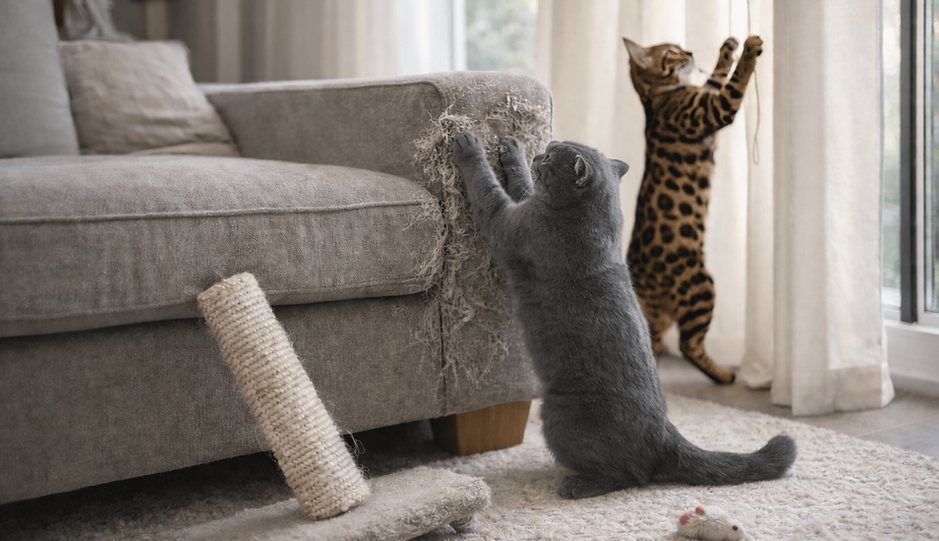
When scratching surfaces and toys don’t support a cat’s need for stability, height, and full-body movement, behavior doesn’t disappear. It redirects to surfaces that feel safer and more functional for the cat. Even with toys present on the ground, cats may preferentially engage with higher, vertical elements like cords or strings, which more closely mimic the movement patterns of prey and align with their natural hunting instincts.
Expecting Toys to Entertain Without Guidance
Toys don’t replace interaction. Without structure, many cats lose interest quickly or become overstimulated.
Leaving Toys Out Constantly
Permanent access often reduces novelty and engagement. Rotation supports curiosity and emotional balance.
This is habituation at work, the same mechanism explained in Why Cats Lose Interest in Toys So Quickly.
Using Toys Only After Problems Appear
Toys are most effective as a preventive tool, not an emergency response.
Choosing Toys or Furniture That Don’t Match a Cat’s Body and Movement
Cats need to stretch fully, brace their bodies, and move confidently. When toys or furniture are too small, unstable, or poorly designed, these needs remain unmet, increasing stress rather than relieving it.
Over time, this mismatch often leads to behaviors being redirected elsewhere in the home, which is why understanding how redirection works and how the environment can be adjusted to support natural movement is such an important part of long-term behavior support.
Toys as a Tool for Redirection
Redirection works best when the alternative offered truly meets the same need as the unwanted behavior. Simply interrupting an action without offering a functional replacement often leads to frustration or escalation.
Effective redirection focuses on matching the behavior to its underlying purpose, rather than trying to suppress it.
For example:
-
Redirecting biting requires toys that allow distance between human hands and the cat’s mouth. Interactive toys such as wand toys support full-body movement and natural hunting sequences without reinforcing hands as targets.
-
Redirecting scratching requires surfaces with appropriate texture, height, and stability, placed where the behavior is already happening. Scratching posts that feel secure and allow full-body stretching are far more effective than attempting to move the behavior through correction alone.
-
Redirecting nighttime activity requires play that is timed earlier in the day and structured enough to release energy before rest. Late-night stimulation without routine often worsens sleep disruption rather than improving it.
This is why toys are not a standalone solution. They work best when combined with thoughtful environmental adjustments and predictable routines that support emotional regulation, as explored in Environmental Enrichment.
(future link)

Cats have different play needs depending on age, energy level, physical ability, and emotional state. Choosing toys that match these differences supports confidence, safety, and emotional balance.
Matching Toys to Individual Cats
There is no universal “best toy for cats.”
Factors that influence toy preferences include:
• age
• energy level
• past experiences
• physical limitations
• emotional sensitivity
Senior cats, anxious cats, and kittens all have different needs. Observing how a cat engages or disengages with toys provides valuable information about their emotional state.
What Toys Cannot Do
It’s important to be realistic about what toys can and cannot accomplish.
Toys cannot:
• resolve chronic anxiety on their own
• replace medical care
• override environmental stressors
• substitute for choice and safety
When toys are treated as a quick fix, guardians often feel discouraged. When toys are used as part of a broader, compassionate approach, they become powerful allies.
When Toys Are Not Enough
If a cat consistently struggles despite thoughtful toy use, this may signal deeper issues such as:
• chronic stress
• pain or discomfort
• environmental overload
In these cases, consulting a veterinarian is an important first step. A qualified behavior professional can also help assess whether additional support is needed beyond play and enrichment.
How This Page Fits Into the Bigger Picture
This page is intentionally focused on understanding toys through a behavioral lens.
For deeper guidance, it connects directly to:
• Play as Enrichment for structured play strategies
• Redirecting Techniques for behavior guidance
• Environmental Enrichment for holistic support
Together, these resources form a framework that prioritizes emotional well-being over quick fixes.
Are toys enough to stop aggressive behavior?
Toys can help reduce frustration and redirect energy, but aggression often has multiple causes. Toys work best alongside environmental adjustments and stress reduction.
How often should I play with my cat?
Short, predictable play sessions are usually more effective than long, sporadic ones. Consistency matters more than duration.
My cat ignores most toys. What does that mean?
It may reflect stress, low energy, past experiences, or a mismatch between the toy and your cat’s natural play style. Observation is key.
Should toys be left out all the time?
Not always. Rotating toys often keeps them engaging and prevents overstimulation or boredom.
When should I seek professional help?
If behavior challenges persist despite thoughtful play and enrichment, consult a veterinarian and consider working with a qualified behavior professional.
Final Thought
Toys are not about keeping cats busy. They are about helping cats cope.
When toys are chosen and used with intention, they support emotional balance, reduce stress, and make redirection more effective. When they are treated as quick fixes, they often fail both the cat and the guardian.
Understanding this difference is one of the most important steps toward a healthier, happier life together.