
UNDERSTANDING YOUR FELINE COMPANION
Lucia Fernandes, Feline Behavior and Environmental Enrichment Specialist (CoE, Oplex Certified)


Cat Scratching Behavior: Why Cats Scratch and How to Redirect It
By Lucia Fernandes, Feline Behavior & Environmental Enrichment Specialist (CoE, Oplex Certified)| Updated April 2026 | 12 min read
QUICK ANSWER
Scratching is not destructive behavior. It is a biological drive with four distinct functions: claw maintenance, muscular stretching, territorial communication, and emotional regulation. Cats scratch specific surfaces in specific locations because those surfaces and locations serve a purpose. Understanding which function is driving the scratching in your cat, and why that particular spot satisfies it, is what makes redirection permanent rather than temporary. Deterrents alone do not work long-term because they address the symptom rather than the need.
Most people who contact me about scratching have already tried the tape, the spray, the tin foil along the armrest. Sometimes these things work for a week. Sometimes the cat moves to a different piece of furniture. What almost nobody has tried is asking what the scratching is actually communicating, because the answer to that question is what determines which approach will work and which will fail.
Scratching is one of the most mismanaged behavior problems in cats, not because it is complicated, but because the default response, covering the furniture in deterrents, addresses the surface and ignores the cat. This guide covers the biology of scratching, how to read what your cat is telling you through the location and pattern of the behavior, and how to match the solution to the actual cause. If the scratching is part of a wider pattern of stress or destructive behavior, that guide covers the broader picture.
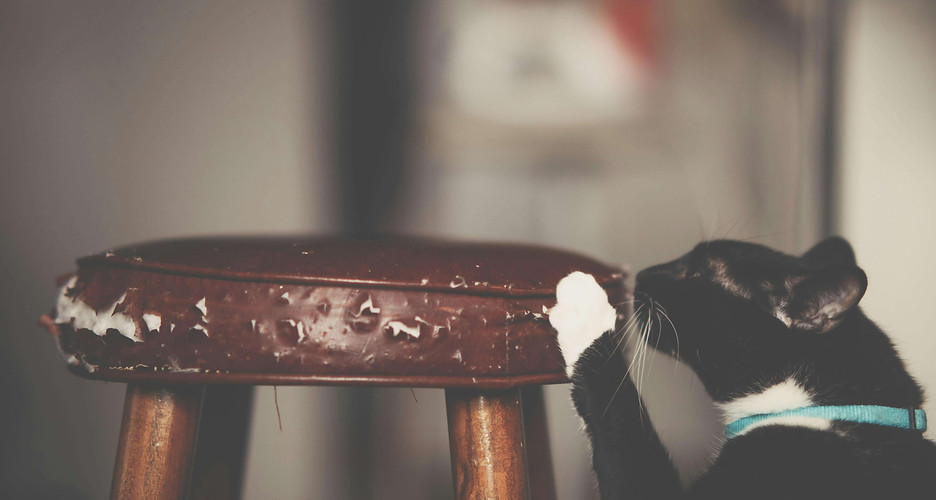
Scientific Insight:
Cats have eccrine glands on their paws that release odor when they scratch. It is extremely helpful in territorial marking and anxiety relief. (Source: Landsberg et al., Behavior Problems of the Dog and Cat) In short: your cat isn't being "naughty" when it scratches, it is talking and maintaining its health.
Why Cats Scratch: The Four Functions
Every scratch a cat makes serves at least one of four purposes. Most scratches serve more than one simultaneously, which is part of why the behavior is so persistent and so resistant to simple deterrence. Removing the surface does not remove the need.
1
Claw Maintenance
Scratching removes the outer sheath of the claw, the dead keratin layer that builds up over time and dulls the tip. Without this mechanism, claws would become overgrown and less functional. This is the function most people are aware of, and it is real, but it is not the primary driver of most furniture scratching. A cat whose claws are well maintained will still scratch furniture if the other three functions are not being met elsewhere.
The practical implication is that trimming nails reduces the damage scratching causes but does not reduce the frequency of the behavior. Nail trimming is a management tool, not a solution.
2
Muscular Stretching
Scratching allows a cat to fully extend and contract the muscles of the back, shoulders, and forelimbs in a way that few other movements do. This is why cats almost always scratch in a long, full-body motion when they are waking up or transitioning between rest and activity. The stretch is the point, not incidental to it.
This function explains why the height and orientation of a scratching surface matters as much as its texture. A post that is too short prevents the full extension the cat is seeking. A post that wobbles under pressure defeats the purpose entirely, because the resistance is what makes the stretch effective.
Myofascial Stretching
The full-body elongation cats achieve during a vertical scratch engages the myofascial system, the connective tissue network surrounding muscles throughout the body. This type of stretching is neurologically satisfying in a way that passive rest is not, which is why cats return to it repeatedly and why a surface that prevents full extension will be rejected in favor of one that allows it.
3
Territorial Communication
Cats have scent glands in the pads of their paws. Every scratch deposits an invisible chemical message onto the surface: a signature that communicates the cat's presence, health status, and territorial claim to other cats and to itself. The visual mark, the torn or roughened surface, amplifies this message by making it legible at a distance.
This function is the most important one for understanding why location matters so much. Cats scratch where the message will be seen and smelled: near doorways, beside resting areas, in the rooms where the family spends most time. The sofa in the living room is the single most high-value communication site in most homes. A scratching post in the spare bedroom is invisible from the perspective of territorial communication, which is why it is ignored.
RESEARCH: Interdigital scent glands in the cat's paw pads release a complex mixture of volatile compounds during scratching. These compounds carry information about the individual cat's identity and reproductive status. Research on feline olfactory communication confirms that scratching marks function as both territorial signals and self-reassurance cues, which explains why cats scratch more, not less, in environments where they feel insecure. Bradshaw, J.W.S., Casey, R.A., & Brown, S.L. (2012). The Behaviour of the Domestic Cat (2nd ed.). CABI.
4
Emotional Regulation
Scratching is a displacement behavior that cats use to manage arousal states they cannot resolve directly. A cat who is excited before feeding, anxious about another animal in the home, or overwhelmed by a change in the household will scratch more, and will scratch with greater intensity, because the act of scratching releases neurochemicals that reduce internal tension.
This function is the one most relevant to sudden increases in scratching behavior. When a cat who has been reliably using a post for years begins scratching furniture again, or when scratching escalates significantly, the emotional regulation function is almost always the explanation. The cat is not forgetting its training. It is managing a state that its previous environment did not require it to manage.
Displacement Behavior
An action performed outside its normal context when a cat is in a state of conflict or unresolvable arousal. Displacement behaviors, including scratching, grooming, and yawning, allow a cat to discharge internal tension when direct action on the source of the tension is not possible. They are signals, not problems. The behavior they displace tells you what the cat is trying to manage.

Stress-related scratching:Changes in routine, visitors, or household activity can increase scratching behavior. Scratching helps cats cope with stress and regain a sense of familiarity in their environment.
Stress-related scratching is often misunderstood as destructive behavior.
In reality, scratching helps cats self-soothe and restore a sense of control when their environment changes.
How to Read What the Scratching Is Telling You
The location, timing, and intensity of scratching are diagnostic. Before deciding on an approach, it is worth spending a few days observing the pattern rather than immediately covering the furniture in tape. The tape can wait. The information cannot be recovered once the behavior changes.
A cat who scratches in one specific spot, at predictable times, in a directed and purposeful way is communicating territorially and may need a better alternative at that location. A cat who scratches in multiple locations, with apparent urgency, particularly after a change in the household, is regulating emotionally and needs the underlying stress addressed alongside any physical changes to the environment. A cat who scratches immediately after waking, in long vertical movements, is stretching, and needs a taller, more stable surface. These look like the same behavior from a distance. The approach required for each is different.
RESEARCH: A 2022 study of 2,465 cat owners found that inappropriate scratching was reported by 58% of participants. Owners who provided enrichment items including flat scratching surfaces and sisal rope, rewarded appropriate scratching, and restricted access to preferred furniture reported significantly fewer incidents of unwanted scratching. Verbal or physical correction was associated with higher rates of unwanted scratching, not lower. Moesta, A., et al. (2022). Unwanted scratching behavior in cats: influence of management strategies and cat and owner characteristics. PMC / MDPI.
The Five Causes of Furniture Scratching
1
The Surface Texture Matches What the Cat Needs
The most common reason a cat scratches a specific piece of furniture is that its texture provides the right resistance for claw maintenance and the right feedback during stretching. Upholstered sofas, woven fabric chairs, and sisal-style rugs offer exactly what many cats are looking for. A post made of soft carpet or loosely wound rope does not.
The fix is not to make the furniture less appealing. It is to provide an alternative that is more appealing, which requires understanding what the furniture is offering and matching or exceeding it.
WHAT TO DO
-
Identify the texture of what is being scratched: fabric, carpet, wood, or leather. Match the post material as closely as possible. Tightly woven sisal rope is the closest equivalent to most upholstery.
-
Choose a post that is at least 60cm tall for an average adult cat. Larger cats need taller posts. The cat must be able to fully extend without reaching the top.
-
Test stability before buying. Push against the top of the post with moderate force. If it moves, the cat will reject it. A weighted base or wall-mounted design is always more stable than a lightweight freestanding post.
2
The Location Is a High-Value Communication Site
Where a cat scratches is not random. Cats scratch where their territorial message will be noticed: near doorways, beside sleeping areas, in the center of social spaces. The living room sofa scores on all of these criteria simultaneously. It is prominent, central, and already carries the scent of the people the cat lives with, making it an ideal communication anchor.
This is why placing a scratching post in a corner or in a room the cat rarely uses almost never works. The cat is not scratching the sofa because it is the only option. It is scratching the sofa because that is where the message needs to be placed.
WHAT TO DO
-
Place the new post directly beside the piece of furniture being scratched, not nearby. The communication function requires the alternative to be in the same location.
-
Once the post is in consistent use for two to four weeks, begin moving it gradually, a few centimetres per day, toward a more convenient location. Sudden moves will result in the cat returning to the furniture.
-
Keep at least one post in the main living area permanently, even after the scratching has resolved. The territorial communication function does not disappear.
3
A Change in the Environment Has Disrupted Scent Anchors
New furniture, a moved sofa, a rearranged room. When a piece of furniture that has accumulated months or years of a cat's scent deposits is removed or replaced, the cat loses an olfactory anchor it has been maintaining and relying on. The response is immediate and instinctive: scratch the new surface in the same location to re-establish the mark.
This is one of the most common triggers I encounter and one of the least recognized by the families I work with. A cat who has never touched the furniture in three years begins destroying a new sofa within two days of delivery. The cat has not changed. The environment has, and the cat is doing exactly what cats do when their scent landscape is disrupted.
WHAT TO DO
-
Place a sisal post beside new furniture before the scratching begins if possible. Prevention is significantly easier than redirection once the habit has formed on the new surface.
-
Use a synthetic pheromone diffuser near the new furniture for the first three to four weeks. This signals to the cat that the area already carries familiar scent, reducing the urgency to scratch.
-
Rub a soft cloth on the cat's cheek and chin and wipe it along the base of the new furniture. Facial pheromone deposits reduce the drive to establish scratch marks in the same area.
4
Territorial Stress from a Change in the Social Environment
The arrival of a new animal, a new person moving in, or significant tension between cats already sharing the home are among the most reliable triggers for escalating scratching. When a cat feels its territory is contested, it will scratch more and in higher-value locations. This is territorial marking under pressure, and it serves a dual function: communicating to the perceived threat and reassuring the cat itself.
The critical distinction here is that this scratching is driven by anxiety, not by physical need. Addressing only the furniture will not help. The underlying social stress needs to be managed. If a new animal arrived recently and the scratching escalated at the same time, the fear and anxiety guide covers what is happening for the cat emotionally and what sustained improvement requires.
WHAT TO DO
-
Increase the number of scratching posts available and distribute them across the spaces the cat considers core territory. One post is rarely sufficient for a cat under territorial stress.
-
Ensure each cat in the household has access to its own scratching surfaces in its own primary areas. Shared posts often go unused by the cat already feeling the social pressure.
-
Address the territorial tension directly through structured introduction protocols or environmental management. The scratching will not resolve while the underlying conflict remains active.
5
Under-Stimulation and Insufficient Play
A cat who is not getting adequate physical and mental stimulation will use scratching as a primary outlet for the arousal that has nowhere else to go. This type of scratching often has a frantic or exaggerated quality and tends to occur at high-energy times of day, particularly in the early morning and around dusk, when the predatory drive naturally peaks.
The connection between play and scratching is underestimated. Structured play sessions that take a cat through the full predatory sequence, hunt, catch, kill, eat, groom, sleep, discharge the arousal that would otherwise be expressed through scratching. A cat who completes two structured sessions per day, with a small meal after the evening session, scratches significantly less than a cat whose predatory drive has no satisfying outlet. The Advanced Play Handbook covers how to run sessions that actually complete this cycle rather than amplify arousal further.
WHAT TO DO
-
Introduce two structured play sessions daily using a wand toy. Each session should run until the cat's interest naturally decreases, not until the owner gets tired.
-
Follow the evening session with a small meal. The hunt-catch-eat-groom-sleep sequence is the most reliable way to reduce overnight and early-morning scratching in younger cats.
-
Add environmental enrichment: window perches, puzzle feeders, rotating toys. A cat with adequate mental stimulation has less arousal to discharge through scratching.
Most scratching posts that end up unused are not failures of the cat. They are failures of the selection criteria. The cat who ignores a post and returns to the sofa is not expressing a preference for furniture. It is expressing a preference for what the furniture offers that the post does not. The question to ask is not why the cat will not use the post. It is what the sofa is offering that the post is not.
Texture
Match the texture of the post to what is being scratched. A cat scratching upholstered fabric needs tightly woven sisal rope. A cat scratching carpet needs a firmer, denser surface than most carpet-covered posts provide. A cat scratching wood or door frames may respond better to a solid wood panel or a sisal-wrapped board mounted flat against the wall. Corrugated cardboard works well for cats who scratch horizontal surfaces. Soft, loosely wound rope is rejected by most cats because it provides insufficient resistance for effective claw maintenance.
Height and Orientation
A post must be tall enough for full extension. For an average adult cat, this means a minimum of 60cm. For large breeds, 75cm or more. The post must also be oriented correctly for the individual cat. Cats who scratch vertical surfaces like sofa arms and door frames need vertical posts. Cats who scratch horizontal surfaces like rugs and doormats need flat or angled options. Many cats use both, and providing one of each is more effective than multiple posts of the same orientation.
Stability
A post that moves when scratched will be rejected within days. Cats put significant force into a scratch, and a surface that shifts or wobbles provides neither the resistance for claw maintenance nor the security for a satisfying stretch. A weighted base, a wall-mounted design, or a post that can be anchored to furniture is almost always more effective than a lightweight freestanding option.
Placement
The most important variable of all. A post placed in the wrong location will be ignored regardless of how well it scores on texture, height, and stability. Place the post where the scratching is currently happening. Once the behavior has reliably transferred to the post, begin moving it gradually toward a more convenient location. Never move it suddenly. Never put it in a room the cat does not use regularly.
Scratching Post Selection and Placement: What Actually Works
Expert Tips for Stubborn Scratchers
-
Use horizontal scratch pads if your cat won't use vertical posts
-
Use sisal-covered ramps or cat trees with integrated posts
-
Rub silvervine or catnip on the new post to make it more attractive
-
Use pheromone diffusers to reduce territorial stress
-
If the cat still returns to furniture, try to block temporarily and reward new scratching areas. Environmental enrichment or additional vertical territory can be added if the behavior persists.
-
Cats scratch more when new animals have been introduced, when moving to a new residence, or when the environment is changed. These situations can be worked through with patience, routine, and reassurance.
What Science Suggests Regarding Scratching
A 2016 study published in the Journal of Feline Medicine and Surgery confirmed that stress, inadequate environmental enrichment, or unmet physical requirements are responsible for most damaging cases of scratching. Cats in enriched environments, with varied surfaces and secure outlets, scratched furniture significantly less.
Source: Ellis, S.L.H., Rodan, I., et al. (2013). AAFP and ISFM guidelines on feline environmental needs.
Diagnostic Checklist: Is Your Cat's Scratching Environment Working?
Most scratching problems are not cat problems. They are environment problems. The setup is missing something, and the cat is using the furniture because the furniture fills the gap. Before trying deterrents or introducing a new post, it is worth auditing what is already in place against the criteria that actually determine whether a cat uses a post consistently.
Research and clinical experience point to the same ten variables repeatedly: whether the cat has both vertical and horizontal options, whether the post is tall enough for a full stretch, whether it is stable under real use, whether the texture matches what the cat is currently scratching, whether it is placed where the cat is already communicating, whether the cat is rewarded for using it, whether play is sufficient to reduce the emotional arousal that drives displacement scratching, and whether any recent change in the household has disrupted the cat's scent environment or territorial security.
A cat that fails on four or five of these criteria is not a difficult cat. It is a cat in an environment that has not been set up to succeed. The checklist below covers each of these variables. The result it generates tells you where to focus first.
Real Case Study
Luna: When the Post Was Right but the Location Was Wrong
Luna was a three-year-old domestic shorthair who had destroyed the back corner of her family's sofa despite having a scratching post that, by any objective measure, should have been adequate. It was tall, made of sisal, and stable. Her guardian Gracie had placed it in the hallway near the litter box because she had read that cats often scratch near their litter area.
When I reviewed the setup, the post was in a low-traffic area with no social significance to Luna. The sofa, by contrast, was in the corner of the living room where the family spent most of their evenings, directly beside the doorway from the hall, and adjacent to the spot where Luna slept during the day. From a territorial communication perspective, the sofa corner was the single highest-value scratching location in the entire home. The post in the hallway was communicating nothing, to no one, about nothing.
We moved the post to the left side of the sofa, exactly where the scratching was occurring. Gracie covered the damaged corner with a piece of cardboard temporarily. Within eight days, Luna was using the post consistently. Within three weeks, the cardboard came off and Luna did not return to the sofa. The post was eventually moved twelve centimetres to the left of its original position over the following month. It has stayed there.
The post was never the problem. The location was everything.
★★★★★
"I had bought what I thought was a good post and Luna completely ignored it. I assumed she just preferred the sofa. Lucia pointed out that the post was in the wrong room entirely and that from Luna's perspective it had no territorial value at all. We moved it next to the sofa and she started using it within the week. Three years of furniture damage stopped in eight days. I wish someone had explained the location thing to me from the beginning."
Gracie, guardian of Luna
Scratching Management Options Compared
Not every approach to scratching management works the same way or serves the same purpose. The three options most commonly discussed are scratching posts, nail trimming, and deterrent sprays or tape. Understanding what each one does, and what it cannot do, prevents the most common mistake: using a deterrent as a primary solution when it is only effective as a temporary bridge.
A scratching post is the only permanent solution. It works by giving the cat an appropriate surface and location that satisfies the biological need. It is recommended for all cats but only works when texture, height, stability, and placement are correctly matched to what the cat is actually looking for. A post that fails on any of these criteria will be ignored.
Nail trimming is a useful management tool for cats whose scratching cannot be fully redirected, particularly senior cats or cats with medical limitations. It reduces the physical damage scratching causes but does not reduce the frequency of the behavior. It needs to be repeated every two to three weeks and requires the cat to be comfortable with handling.
Deterrent sprays and tape are temporary bridges, not solutions. They make a specific surface less appealing while the post habit is forming, but a cat deterred from one spot will find another if no appropriate alternative is available. They are largely ineffective for cats under significant territorial stress, where the drive to mark overrides mild aversive signals.
Key Takeways
-
Scratching serves four distinct biological functions. Removing access to one surface does not remove the need. Redirection, not suppression, is the only approach that works long-term.
-
Location is the most important variable in scratching post success. A post placed in the wrong location will be ignored regardless of its quality. Place it where the scratching is happening, not where it is convenient.
-
New furniture, moved furniture, or any change that removes established scent anchors will reliably trigger scratching on the new surface. This is biology, not misbehavior.
-
Scratching that escalates after a new animal arrives is territorial stress behavior. Deterrents will not resolve it while the underlying social tension remains unaddressed.
-
Structured play that completes the full predatory cycle significantly reduces scratching driven by under-stimulation and emotional arousal. Two sessions per day with a meal after the evening session is the baseline.
-
Punishment for scratching increases stress and worsens the behavior. It does not teach the cat where to scratch. It teaches the cat that you are unpredictable.
Why Most Scratching Advice Falls Short
Scratching is one of the most natural behaviors a cat can display, yet it's also one of the most misunderstood. Most advice focuses on protecting your furniture rather than understanding why your cat chose that particular surface in the first place.
The recommendations are usually familiar: buy a scratching post, cover the furniture, apply deterrent sprays, or move the cat whenever they scratch in the wrong place. Yet many owners have already tried all of these before they arrive here. The scratching post is there. The deterrents have been used. And the cat still returns to the same corner of the sofa.
That happens because scratching isn't simply a habit to stop. It's a normal behavior that serves multiple functions, from maintaining claws and stretching muscles to communicating territory, relieving tension, and responding to a cat's emotional state. Until you understand why your cat has chosen one particular surface over another, changing where they scratch becomes little more than trial and error.
Surface texture, location, previous learning, household routines, territorial significance, and emotional state all influence that decision. Two cats may repeatedly scratch the same piece of furniture for completely different reasons, which is why advice that works perfectly for one cat often has little effect on another. I see this constantly in behavior consultations. Two owners describe what appears to be the exact same problem, yet the underlying cause turns out to be completely different.
That gap between generic advice and your individual cat is exactly why I wrote Scratching Solved.
The framework in this book is based on the same principles I use in behavior consultations, where understanding the function of the behavior always comes before choosing the solution. Rather than giving you another list of tips to work through one by one, it teaches you how to identify why your cat is scratching a particular surface and how to redirect that behavior in a way that works with your cat's natural instincts instead of against them.
Once you understand the reason behind the scratching, the right intervention often becomes surprisingly clear, not because your cat has changed, but because you're finally addressing the real cause of the behavior instead of its visible symptoms.
Lasting behavior change doesn't come from stopping a cat from scratching. It comes from giving them a better reason to scratch somewhere else.

Final Thought
Scratching is not a problem to be suppressed. It is a biological need, a form of communication, and a mechanism for emotional regulation that cats cannot simply stop having because it is inconvenient. Nail caps and declawing share the same fundamental flaw: they treat the symptom while ignoring what the cat is trying to express, and they do so at the cat's expense.
My position on both is the same. They are not solutions. They are refusals to listen. Every cat that scratches furniture is telling you something specific about what its environment is missing. The answer is always to understand that, and to respond to it.
Frequently Asked Questions
Why do cats scratch furniture?
Cats scratch to stretch their bodies, maintain their claws, mark territory, and release tension. Furniture scratching usually happens when appropriate scratching options are unavailable or poorly placed. Cats are also drawn to surfaces that carry their scent or are located in socially significant areas, which is why the corner of the sofa is almost always more appealing than a post tucked away in a back room. The drive to scratch is biological and will not stop. The goal is always redirection, not elimination.
Can stress or anxiety increase scratching behavior?
Yes. Stress, changes in routine, or environmental insecurity can increase scratching significantly as a coping behavior. Scratching helps cats self-regulate and feel more secure in their environment. If your cat's scratching has intensified recently, consider what may have changed. New pets, visitors, renovations, or shifts in your daily routine can all be enough to trigger an increase. The anxiety in cats guide covers the mechanisms behind stress-driven behavior and what lasting improvement requires.
Should I punish my cat for scratching?
No. Punishment increases fear and stress, often making the behavior worse. Cats do not associate punishment with the act that caused it. They associate it with you, which damages trust and increases anxiety. Redirecting scratching to appropriate surfaces and rewarding correct use is far more effective and far kinder. A cat that is punished for scratching does not learn where to scratch. It learns that you are unpredictable.
How do I stop my cat from scratching the sofa?
The most effective approach is redirection, not prevention. Place a scratching post directly next to the furniture your cat is targeting, same location, similar texture if possible. Make the post appealing with catnip or silvervine and reward every time your cat uses it. Covering the damaged area temporarily with double-sided tape or a furniture guard removes the preferred texture while the new habit forms. Once the scratching shifts to the post, you can gradually move it to a more convenient location over several weeks. For the practical step-by-step process, the how to stop cat scratching furniture guide covers every stage including what to do when progress stalls.
Is scratching related to stress or a sign that something is wrong?
Not always, but sometimes. Scratching is a normal healthy behavior in all cats. However, a sudden increase in scratching, new scratching locations, or scratching combined with other stress signals such as hiding, overgrooming, or changes in appetite can indicate that your cat is feeling emotionally overwhelmed. In these cases, the scratching is not the problem. It is the message. Addressing the underlying stress usually reduces the behavior without any direct intervention on the scratching itself. The environmental enrichment guide covers the changes that make the biggest difference to a cat's baseline stress level.
How many scratching posts does a cat need?
For a single cat in a standard home, a minimum of two posts in different rooms: one near the primary sleeping area and one in the main living space. For multi-cat households or cats under territorial stress, more is better. The general principle is that scratching resources should be distributed across the cat's core territory. Each cat should have access to at least one post in its primary zone. If scratching is currently a problem, add a post wherever the damage is occurring before thinking about long-term placement.
Why does my cat scratch more after I introduced a new cat?
Scratching increases under territorial stress, and the arrival of a new cat is one of the most reliable stress triggers for a resident cat. The resident cat is marking more to reinforce its territorial claim in a space that now feels contested. This is not misbehavior. It is a direct response to a perceived threat. Deterrents will not help while the social tension remains unresolved. Addressing the introduction properly, through scent swapping, gradual visual access, and separate resource areas, is the correct intervention. The fear and anxiety guide covers multi-cat dynamics in detail.
When General Advice Isn't Enough
Scratching is a natural behavior, but the reasons behind it are rarely as simple as they seem. One cat may scratch to communicate territory, another to cope with stress, and another because they've developed a strong preference for a particular surface or location. That's why generic advice often falls short. If you've already tried the usual recommendations without seeing lasting improvement, it's usually a sign the behavior needs a more individual assessment
NEED DIRECT SUPPORT?
Every cat and every situation is different. I don't do generic advice. I look at what is actually happening with your cat and build a plan around that specific case.
If you would like personalised guidance based on your cat's specific behavior, history, and environment, find out how we can work together.
Explore This Topic Further
Related pages on scratching, destructive behavior, and the environmental factors that drive both.
How to Stop Cat Scratching Furniture - What Actually Works - Blog Post The practical step-by-step guide to redirecting furniture scratching permanently.
How Luna Stopped Scratching the Sofa - Case Study A real case of furniture scratching resolved through post placement, not deterrents.
Destructive Cat Behavior - How scratching fits into the broader picture of destructive behavior and what drives each type.
Fear and Anxiety in Cats - Hub Page For cats whose scratching is driven by stress, territorial anxiety, or social conflict.
Anxiety in Cats: Signs, Causes and What Helps - The mechanisms behind chronic anxiety and the interventions that produce lasting change.
Environmental Enrichment for Cats -The foundational environmental changes that reduce under-stimulation and the behaviors it produces.
References
-
Moesta, A., & Crowell-Davis, S. (2011). Scratching behaviour in domestic cats. Journal of Feline Medicine and Surgery, 13(11), 840-847.
-
Moesta, A., et al. (2022). Unwanted scratching behavior in cats: influence of management strategies and cat and owner characteristics. PMC / MDPI.
-
Ellis, S.L., Rodan, I., Carney, H.C., et al. (2013). AAFP and ISFM Feline Environmental Needs Guidelines. Journal of Feline Medicine and Surgery, 15(3), 219-230.
-
Overall, K.L. (2013). Manual of Clinical Behavioral Medicine for Dogs and Cats. Elsevier Mosby.
-
Landsberg, G., Hunthausen, W., & Ackerman, L. (2013). Behavior Problems of the Dog and Cat (3rd ed.). Saunders Elsevier.