


Why Is My Cat Following Me Everywhere? Attachment vs Anxiety

Updated: Sep 21
Quick Answer
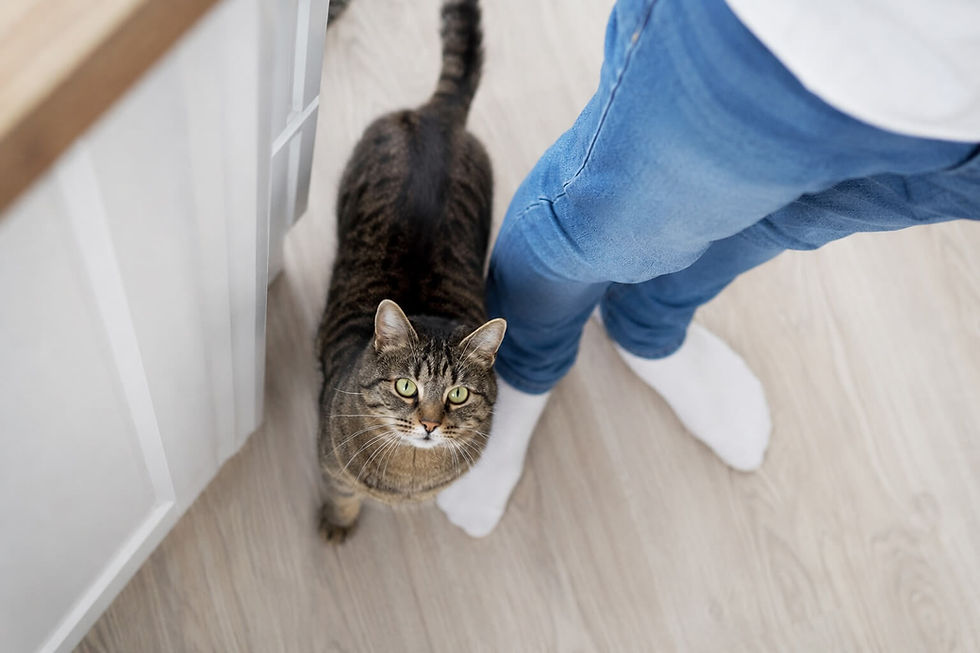
If your cat follows you everywhere, it is usually expressing one of three things: secure attachment and a preference for your company, a learned association between your movement and good things like food or play, or an unmet need that has made proximity to you feel necessary. Following behavior only becomes a concern when it is accompanied by distress, vocalisation, or an inability to settle when you are out of sight. Most cats who follow their owners are not anxious. But some are, and the difference matters.
Common reasons your cat follows you everywhere
Secure attachment and social preference
Learned association with food or play
Boredom or insufficient stimulation
A recent change in routine or environment
Separation anxiety and attachment distress
Illness or physical discomfort
WHY IS MY CAT FOLLOWING ME EVERYWHERE ALL OF A SUDDEN?
A sudden increase in following behaviour usually indicates a recent change: a shift in your work schedule, increased absence, a new person or animal in the home, or physical discomfort. When following starts abruptly rather than being a longstanding personality trait, a medical cause should always be ruled out first, particularly in cats over seven years old.
Most people ask this question with a slight smile. Their cat has followed them to the bathroom again, sat outside the shower, or appeared from nowhere the moment they stood up from the sofa. It is, in most cases, entirely normal. But occasionally someone asks it with genuine concern, because the following feels compulsive, or the cat becomes distressed when left alone, or the behavior changed suddenly after something shifted in the household.
In my work as a feline behavior and environmental enrichment specialist, I have worked with both types, and they need completely different responses. This page covers the full picture: the benign reasons a cat becomes a shadow, the situations where following signals something that needs addressing, and how to tell which one you are dealing with. If you are already fairly sure anxiety is involved, the anxiety in cats page covers the broader pattern in detail.
Why Cats Follow Their Owners: The Real Causes
1 - Secure Attachment and Social Preference
Cats are not the solitary creatures they are often described as. Research on feline social behavior has consistently shown that domestic cats form genuine attachments to their owners, and that they use humans as a social resource in ways that parallel how they relate to trusted members of their own species. A cat who follows you is, in many cases, simply expressing that you are part of their social group and that being near you is comfortable.
This is especially common in cats who were well socialised with humans during the sensitive period between two and seven weeks of age, in cats who have lived with the same person for many years, and in cats who are the only animal in the household. It does not indicate need or anxiety. It indicates preference. The cat is choosing to be near you the same way you might choose to sit in the same room as someone you like.
Research
Vitale Shreve and Udell (2017) reviewed evidence for social cognition in domestic cats and concluded that cats form selective attachments to specific individuals, use their owner's presence as a secure base for exploration, and display stress responses when separated from bonded humans, behaviours that parallel secure attachment in other species.
Vitale Shreve, K.R., & Udell, M.A.R. (2015). What's inside your cat's head? A review of cat (Felis silvestris catus) cognition research past, present and future. Animal Cognition, 18, 1195–1206.
What This Means for You
No action needed. This is normal social behavior.
Enjoy it without encouraging it to the point of dependence. Short separations are healthy and help prevent anxiety from developing.
If the following feels excessive or the cat becomes distressed when you leave, move to cause 5 below.
2 - Learned Association With Resources
Cats are creatures of habit. If your movement through the house has historically predicted meals, treats, play sessions, or access to a room they like, they will follow you because your movement has become a reliable cue for something good. This is not manipulation. It is basic associative learning, and it happens so gradually that most owners do not notice it developing.
The most common version: a cat who follows you to the kitchen every time you stand up, not because it is hungry but because standing up has become associated with the possibility of food. The same mechanism applies to play. If you have ever picked up a wand toy and played with your cat when they came to find you, you have reinforced the following behavior in exactly the way that makes it persist.
What to Do
Feed at fixed times rather than in response to following or vocalisation. This removes the reinforcement that maintains food-related following.
Initiate play proactively at set times rather than reactively when the cat appears. This shifts the cat from seeking play to anticipating it.
If resource-related following is the primary behaviour, the why does my cat meow so much page covers the full management approach for food-seeking and attention-seeking vocalisation.
3 - Boredom and Insufficient Stimulation
An indoor cat with limited environmental enrichment will often redirect its need for activity, novelty, and engagement onto the humans in the household. You become the most interesting thing in the environment. The cat follows you not because it is particularly attached to you in an emotional sense, but because you move, change location, make sounds, and generally provide more stimulation than a static room does.
This type of following tends to be accompanied by other signs of understimulation: restlessness, play aggression, excessive vocalisation, disrupted sleep patterns, or destructive behavior. The cat is not being demanding. It is expressing a legitimate biological need for more activity than its current environment provides.
Environmental Enrichment
The practice of modifying a cat's living environment to provide opportunities for species-typical behaviors including hunting, climbing, scratching, hiding, and social interaction. Adequate enrichment reduces boredom-driven behaviors by meeting the cat's behavioral needs through the environment rather than through human attention.
What to Do
Introduce structured play sessions twice daily using a wand toy. Ten to fifteen minutes of active predatory play is enough for most adult cats.
Add vertical space: cat trees, shelves, and window perches give the cat destinations that are not you.
Rotate toys regularly. A toy that has been available for weeks is no longer novel and will not hold the cat's attention.
Consider puzzle feeders for at least one meal per day. They slow eating and engage the cat's foraging instinct.
4 - A Recent Change in Routine or Environment
Cats regulate themselves partly through predictability. When something in the household changes, whether that is a house move, a new person or animal, a shift in your work schedule, or even a rearrangement of furniture, some cats respond by staying closer to the person or thing they trust most. The following is a proximity-seeking behavior driven by mild uncertainty, not full anxiety. The cat is using you as a safe base while it recalibrates.
This kind of following typically resolves on its own within days to a few weeks as the cat adapts to the new normal. It does not need to be discouraged. Gently tolerating the proximity while maintaining your own routine is usually the most effective approach. Forcing independence at this stage can backfire by making the uncertainty feel worse.
What to Do
Maintain feeding, play, and sleep routines as consistently as possible during the transition period. Predictability is the fastest route back to baseline.
Allow the proximity without reinforcing distress. Let the cat sit nearby but do not reward vocalisation or pawing with immediate attention.
If the change involved a new animal in the home, the how to introduce a new cat guide covers how to manage the transition in a way that reduces territorial stress for the resident cat.
5 - Separation Anxiety and Attachment Distress
This is the cause that matters most to identify correctly, because it is the one that needs a different response. A cat with separation anxiety does not just follow you out of preference or habit. It follows you because being out of your proximity produces genuine distress. These cats often shadow every movement, become agitated when you prepare to leave, vocalise excessively when you are gone, and may show physical symptoms including changes in appetite, over-grooming, or inappropriate elimination.
Separation anxiety in cats is more common than it was historically recognised to be, and it is frequently misread as affection or clinginess. The distinction is not about how much the cat follows you. It is about what happens when it cannot. A securely attached cat, separated from its owner, will settle. A cat with separation anxiety will not.
If your cat has become more intense or needy, this may be closer to clingy behavior rather than normal following.
Separation Anxiety in Cats
A condition in which a cat experiences significant psychological distress when separated from a specific attachment figure, typically a primary owner. Unlike normal proximity-seeking, separation anxiety produces a stress response that the cat cannot self-regulate, and it typically worsens without targeted intervention.
Research
Schwartz (2002) described feline separation anxiety as an under-recognised condition in domestic cats, noting that the most consistent indicators are excessive vocalisation, destructive behaviour, and inappropriate elimination specifically in the owner's absence, often concentrated on the owner's personal items. The study highlighted that cats with high attachment levels and limited social contact were most commonly affected.
Schwartz, S. (2002). Separation anxiety syndrome in cats: 136 cases (1991–2000). Journal of the American Veterinary Medical Association, 220(7), 1028–1033.
What to Do
Do not punish or discourage following directly. This increases the cat's anxiety without addressing its cause.
Build independence gradually through short, predictable departures that the cat can habituate to over time.
Create a rich environment with food puzzles, play opportunities, and safe hiding spots so the cat has resources available when you are absent.
Avoid prolonged pre-departure rituals. A calm, consistent goodbye routine is better than extended reassurance that can inadvertently signal that departure is something to worry about.
For moderate to severe cases, consult a vet before trying supplements or medication. Some cases of separation anxiety respond well to environmental intervention alone. Others need pharmaceutical support to make behavior modification possible.
6 - Illness or Physical Discomfort
A cat that suddenly begins following you more than usual, especially if this represents a clear change from its normal behavior, may be experiencing physical discomfort. Cats instinctively suppress obvious signs of pain, but many will seek proximity to a trusted person when they are unwell in a way that reads as clinginess rather than illness. This is particularly common in older cats dealing with the early stages of arthritis, hyperthyroidism, or cognitive dysfunction.
The key signal is change. If your cat has always been a follower, this is personality. If the following started abruptly or intensified noticeably over a short period, and particularly if it is accompanied by other changes such as altered appetite, increased vocalisation, changes in litter box use, or reduced grooming, a vet visit is the right first step before any behavioral interpretation.
What to Do
Note when the change started and what else changed around the same time.
Book a vet check if the behaviour shift was sudden and is accompanied by any other changes, however subtle.
In senior cats (10 years and older), sudden changes in proximity-seeking or attachment behaviour are worth investigating as a standard part of geriatric care.
Real Case
Theo: When Following Was the First Sign of Something Deeper
Theo was a four-year-old male neutered domestic shorthair whose owner, Jorge, contacted me because Theo had started following him everywhere and crying at the bathroom door. Jorge found it endearing at first. After two weeks it was beginning to feel like something was wrong.
When we went through Theo's history, the timeline was clear: the following had started three weeks earlier, shortly after Jorge began working longer hours and was away from the house for ten to twelve hours at a stretch. Theo had always been attached, but the extended absences had pushed that attachment into genuine distress. He was not just a follower. He was a cat whose environment had stopped providing enough to keep him occupied and regulated while his primary person was absent.
The intervention was straightforward: two structured play sessions per day using a wand toy, a puzzle feeder at lunchtime via an automatic dispenser, and a gradual extension of the departure routine so Theo could habituate to the transitions rather than being thrown into them. Within three weeks the vocalisation at the bathroom door had stopped. The following reduced to what it had always been: a cat who liked to be in the same room, not a cat who could not function without contact.
★★★★★
"Theo started following me everywhere when I went back to the office. I assumed he would adjust. Lucia helped me understand he was not adjusting, he was waiting. Two play sessions a day and a puzzle feeder felt too small to matter. They were not."
Jorge, guardian of Theo
Normal Following vs. Anxiety-Driven Following
A cat with secure attachment settles when you leave the room. It may glance toward the door, but within a few minutes it finds a resting spot and relaxes. A cat with separation anxiety does not settle. It vocalises, paces, or stays at the door for most of your absence. During the time you are away, a securely attached cat eats, plays, and sleeps normally. An anxious cat often refuses food, and neighbors sometimes report vocalisation that the owner never witnesses directly.
The greeting on return is another clear signal. A secure cat is pleased to see you but calm. It approaches, rubs, and then continues with its day. An anxious cat greets with intensity that does not wind down, sometimes vocalising and shadowing for a long period after you come back. Pre-departure cues tell a similar story. Keys, a bag, shoes: a secure cat notices these without significant reaction. An anxious cat becomes agitated, vocalises, or tries to block the door when it reads those signals. Physically, secure cats show no changes in weight, coat condition, or litter box use. Anxious cats sometimes over-groom, lose appetite, or avoid the litter box. And finally, duration: if following has been a consistent part of your cat's personality throughout its life, that points toward temperament. If it started or intensified sharply after a specific change, that points toward anxiety.
If You Are Concerned: What to Do First
If your cat is showing signs of distress when you move away or leave the house, there is a clear order of steps that works. Start with the physical before assuming the cause is behavioral. A vet check rules out pain, hyperthyroidism, and early cognitive decline, all of which can present as sudden clinginess and all of which resolve without any behavioral intervention if caught early.
Once medical causes are ruled out, map what changed. Go back three to four weeks before the following intensified and look at work schedule, household composition, the arrival of a new animal, or even a rearrangement of furniture. Cats are acutely sensitive to changes that humans consider minor. Identifying the trigger determines your next step.
The third step is enrichment, and it needs to happen before your next absence, not after the cat is already distressed. Two structured play sessions per day using a wand toy and at least one puzzle feeder give the cat something to do other than wait for you to come back. This alone resolves many cases.
From there, practice short and calm departures. Leave for five minutes, come back, leave for ten minutes, come back. Irregular intervals matter because they prevent the cat from building a fixed expectation of how long you will be gone. Calm arrivals and departures are more effective than prolonged reassurance, which can signal to the cat that your leaving is something worth worrying about.
The fifth step is the one most owners find difficult: do not reinforce the distress signal. If your cat vocalizes at the bathroom door and you open it, you have taught it that distress produces the outcome it is seeking. Respond to calm behavior. Ignore vocalization once you have confirmed the cat is physically fine.
Reassess after three weeks of consistent effort. Most cases driven by boredom or mild routine disruption resolve within that window. If the distress signals remain unchanged after three weeks, the situation needs a closer look at what specifically is maintaining it.
Key Takeaways
A cat following you everywhere is usually expressing secure attachment, a learned association with resources, or a need for more stimulation. It is not inherently a problem.
The distinction between normal following and anxiety-driven following is not frequency. It is what happens when the following is interrupted and whether the cat can settle in your absence.
Sudden onset following in a cat that was previously independent is worth a vet check before any behavioral interpretation, particularly in cats over ten years old.
Boredom is one of the most common and most underestimated reasons cats shadow their owners. Two structured play sessions per day and at least one puzzle feeder resolve many cases entirely.
Separation anxiety in cats is real, more common than previously recognised, and responds well to a combination of environmental enrichment and gradual habituation to departures.
Reinforcing distress by responding to vocalisation or door-scratching makes anxiety-driven following worse over time, even when done with kind intent.
A cat that follows you is not being difficult. In most cases, it is telling you that you matter to it. What matters is whether the behavior is coming from security or from need.
Most cases of following behavior respond to the steps described here. A clearer routine, more structured play, a puzzle feeder, short departures practiced consistently. For many cats, that is genuinely enough.
But some cats do not shift with general guidance alone. The anxiety is too established, the enrichment is not landing, or the behavior has been reinforced for long enough that it has become a pattern the cat does not know how to leave. In those cases, what is missing is not more information. It is a plan built around what is specifically happening with your cat, what it actually engages with, and what its history makes it more or less likely to respond to.
The Advanced Play Handbook was written for exactly this gap. Not as a replacement for working through the basics, but as the next layer for owners who have done everything right and are still watching their cat wait by the door.
When General Advice Isn't Enough
Most following behavior falls into patterns that respond well to the approaches described here. But some cats have more complex histories, and some situations involve multiple interacting causes that general advice cannot untangle. If you have worked through these steps and the behavior has not shifted, or if the distress signals are significant, that is usually a sign that the situation needs a closer look at what is specifically happening with your cat.
Work With Me
Need Direct Support?
If your cat is still following you everywhere or cannot settle when you leave despite consistent effort, it usually means something specific is maintaining the pattern. Adjusting the environment and routine alone is not enough at that point. I look at what is actually driving the behavior in your cat's specific case and build a plan around that.
Frequently Asked Questions
Is it normal for cats to follow you everywhere?
Yes, for the majority of cats this is entirely normal behavior. Cats that are well bonded to their owners will often choose to be in the same room, follow movement through the house, and seek proximity during rest periods. This does not indicate anxiety or an unhealthy attachment unless it is accompanied by signs of distress when you are absent. If you are unsure whether what you are seeing is normal attachment or something more, the anxiety in cats page covers the distinction in detail.
Why does my cat follow me to the bathroom specifically?
The bathroom is a room you enter and close the door, which from the cat's perspective is a sudden and unexplained reduction in access to you. Cats that are moderately attached often find door-closing more activating than simple movement through open space, because it represents a small but real separation. Many cats have also learned that appearing at the bathroom door produces attention, which reinforces the behavior regardless of the underlying motivation.
My cat started following me everywhere after I went back to work. What is going on?
This is one of the most common presentations I see. A cat that was used to having you home has adapted to that level of access, and the sudden reduction in your presence creates a gap that the cat tries to close by intensifying proximity when you are home. The most effective response is to increase structured enrichment, particularly play and puzzle feeding, during the hours you are absent, and to maintain a calm and consistent routine around departures and returns rather than compensating with extended attention when you are home.
How do I know if my cat following me is separation anxiety or just affection?
The clearest way to tell is to observe what happens when you are gone rather than when you are present. A cat with a secure attachment will miss you but function: it will eat, use the litter box, and sleep normally. A cat with separation anxiety will struggle to regulate without you. Set up a camera or ask a neighbor to observe for a short period. If the cat settles within fifteen to twenty minutes of your departure, the following is likely attachment-based and not a clinical concern. If the distress signals persist for most of your absence, that pattern warrants intervention. The signs of anxiety in cats page can help you identify what to look for.
Should I let my cat follow me everywhere or try to discourage it? If the following comes from a secure, settled cat with no signs of distress, there is no reason to discourage it. Cats benefit from social contact with their owners and choosing to be nearby is a healthy expression of that. Where it makes sense to build independence is when the following is anxiety-driven, or when you want to prevent an overly dependent dynamic from developing. In that case, the approach is not to push the cat away but to enrich the environment sufficiently that the cat develops reasons to be elsewhere, and to respond to settled behavior rather than to proximity-seeking.
My cat has always been independent but recently started following me constantly. What has changed?
A sudden shift from independence to clinginess in a previously self-sufficient cat is worth taking seriously, particularly if the cat is middle-aged or older. It can reflect a change in the household that has made the cat feel less secure, a medical issue driving proximity-seeking, or early signs of cognitive change in senior cats. Map what changed in the three to four weeks before the behavior started and book a vet check if nothing obvious accounts for it. This is one of those situations where physical causes need to be ruled out before any behavioral explanation is assumed.
I have tried everything and my cat still cannot settle when I am out of the room. What am I missing?
Persistent inability to settle in your absence despite enrichment and routine work usually means one of three things: the enrichment is not matched to what this specific cat finds engaging, there is an underlying physical cause that has not been identified, or the anxiety level is high enough that environmental intervention alone is not sufficient and medical support is needed to make behavior modification possible. In these cases, a direct assessment is more useful than more general advice. If you are at that point, working directly with me is the next step.
Continue Exploring
Related pages on cat attachment, anxiety, and the behavioral patterns that drive following and clingy behavior.
Why Is My Cat Hiding All of a Sudden? - The other side of proximity-seeking: what hiding tells you about a cat's stress state and how to respond.
Signs of Anxiety in Cats - How to identify anxiety in cats that do not show obvious signs, including the subtler signals that following behavior often masks.
How to Calm a Stressed Cat - Practical steps for reducing the underlying stress that drives both following and inability to settle alone.
Fear and Anxiety in Cats - The broader framework for anxiety-driven behavior in cats, including separation anxiety, hypervigilance, and environmental triggers.
Anxiety in Cats - Deep Dive The biology, causes, and treatment approaches for feline anxiety in full detail.
Cat Behavior Problems - Overview of the most common feline behavior problems and where to start with each.
Final Thought
A cat that follows you everywhere is not a problem to be managed. In most cases it is a cat that has decided you are worth being near, and that is not nothing. What matters is whether the following comes from a place of security or from a place of need. The first is a compliment. The second is a request for help. Learning to tell the difference is the most useful thing you can do for your cat.
References
Vitale Shreve, K.R., & Udell, M.A.R. (2015). What's inside your cat's head? A review of cat (Felis silvestris catus) cognition research past, present and future. Animal Cognition, 20(6), 1195–1206. ResearchGate
Schwartz, S. (2002). Separation anxiety syndrome in cats: 136 cases (1991–2000). Journal of the American Veterinary Medical Association, 220(7), 1028–1033. PubMed


Comments