


Why Is My Cat Suddenly Clingy? What Changed and What It Means

Updated: Sep 7
A cat that suddenly becomes clingy is almost always responding to a change that affects how safe or predictable the environment feels.
QUICK ANSWER
A cat that suddenly becomes clingy is usually responding to a change in their environment, routine, or emotional state.This behavior often reflects increased insecurity, stress, or a stronger need for reassurance. While some clinginess is normal, a sudden change usually means your cat is trying to regain a sense of safety.

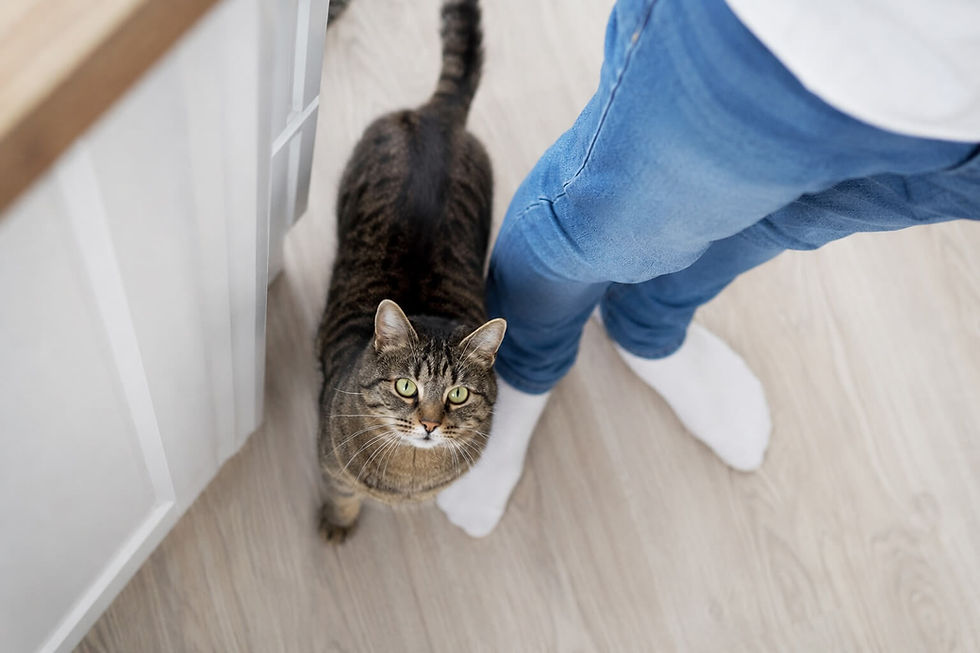
Your cat is suddenly always there.
They follow you more closely, settle on top of you instead of nearby, and seem to need constant contact. Maybe they were always affectionate, but this feels different. More intense. Harder for them to switch off.
Sudden clingy behavior in cats is usually caused by a change that affects how safe or predictable the environment feels. The distinction that matters is this: a cat who enjoys being near you is not the same as a cat who needs you to feel stable.
In my work with clients, this behavior is rarely random. It almost always has a cause.
Common reasons your cat suddenly becomes clingy:
A change in environment
A disruption in routine
Increased anxiety
Lack of stimulation
Physical discomfort
Is It Normal for a Cat to Suddenly Become Clingy?
Not exactly. Cats can become more affectionate over time, but sudden clingy behavior usually has a cause. Most often, it reflects a shift in how safe or predictable the environment feels to the cat.
A cat who becomes clingy is not just seeking attention. They are trying to regulate something they no longer feel able to manage on their own.
Some cats who seem clingy are actually showing a more intense version of normal following behavior. If your cat has always stayed close to you but has recently become more dependent, it helps to understand the difference between the two. You can read more about that in Why Is My Cat Following Me Everywhere?
What Causes Sudden Clingy Behavior in Cats?
When I assess a cat for sudden clinginess, I am looking for a trigger, because this behavior is almost always caused by a change in how safe or predictable the environment feels. These are the causes I see most.
CAUSE 1 - A Change in Environment
Cats rely on predictability. Their sense of safety comes from an environment they can read and navigate. When that changes, many cats respond by staying closer to the one thing that still feels stable: you.
This is not limited to major changes like moving house. Smaller shifts, such as rearranging furniture or introducing a new animal, can also change how safe the space feels. The clinginess is often your first visible sign that something has shifted in how your cat is reading the environment.
CAUSE 2 - Changes in Routine
Cats calibrate their sense of security through the regularity of what happens around them: when food arrives, when people come and go, when the house is quiet. When those rhythms shift, the cat loses the ability to anticipate what comes next.
If you have changed work hours, started spending more time at home, or altered feeding times, your cat may start tracking you more closely. The clinginess, in this case, is information-seeking behavior.
Emotional Dependency vs. Normal Attachment
A cat with normal attachment seeks proximity because it is pleasant. A cat with emotional dependency seeks proximity because it is necessary. The difference is whether your cat can settle comfortably without contact, or whether separation creates visible distress.
Cause 3 - Increased Anxiety
Some cats become clingy not because of a single event, but because their overall anxiety level has risen. When a cat can no longer self-regulate, they borrow that regulation from a source they trust. You become the anchor.
This is not simple affection. It is emotional dependence, and it tends to intensify if the underlying anxiety is not addressed.
What You Might Notice
Difficulty settling unless in contact with you. Following without pauses. Heightened alertness or startle responses. Vocalising when you leave the room.
Research
Research by Vitale Shreve et al. (2017) found that the majority of cats choose human social interaction over food, scent, and toys when given a free choice. For anxious cats, this preference for proximity is likely amplified as a coping response rather than simple sociability. Pubmed
Cause 4 - Reduced Stimulation
When a cat is not getting enough structured activity, they redirect that need for engagement onto the people around them. Instead of interacting with their environment, they interact with you. Constantly.
This can look like affection, but it is more accurately read as a cat with unmet needs. The clinginess is not about you specifically. It is about a gap the cat is trying to fill.
Cause 5 - Subtle Health or Discomfort Changes
Behavior changes sometimes precede visible physical signs. A cat who feels unwell or is in early-stage pain will often seek more contact. Proximity to a trusted person provides a sense of safety when something feels wrong.
When to Act Quickly
If the clinginess is accompanied by reduced appetite, changes in grooming, altered litter box use, or visible discomfort, contact your vet. Behavior changes are frequently the first indicator of physical problems.
Real Case Study
Maisie and the Return to the Office
Maisie's owner, Claire, contacted me after working from home for two years and then returning to the office full-time. Within a week, Maisie had become what Claire described as glued to her during evenings and weekends. She could not sit down without Maisie on her lap, and Maisie would begin vocalising whenever Claire moved to another room.
Maisie was not anxious by nature. She was a confident cat who had, over two years, restructured her entire day around Claire's presence. The sudden withdrawal of that contact was experienced as a significant loss of predictability.
We worked on rebuilding independent rest stations, reintroducing structured play at specific times, and ensuring Maisie had a consistent feeding schedule that was not dependent on Claire being home. The vocalising reduced within three weeks. The constant lap behavior followed.
The key was not reducing affection. It was rebuilding the structure around it.
★★★★★
"Maisie had been glued to me for weeks and I genuinely did not understand why. I thought I had done something wrong. Lucia asked me to think back to exactly when it started and whether anything had changed at home. I had not connected it to going back to the office because it seemed too obvious, but that was it. She explained what Maisie was actually experiencing and gave me a very clear plan. Within a few weeks Maisie was settling on her own again. I still sit with her every evening, but now it feels like a choice for both of us. That difference matters more than I expected."
— Claire, guardian of Maisie
The Difference Between Normal Attachment and Clingy Behavior
The difference between normal attachment and clingy behaviour comes down to one thing: choice vs need.
A normally attached cat chooses to be near you
A clingy cat needs to be near you
A normally attached cat can settle alone
A clingy cat struggles without contact
A normally attached cat stays calm when you move away
A clingy cat follows immediately and may vocalise
A normally attached cat adapts to small changes
A clingy cat is disrupted by them
Clingy behavior becomes a concern when your cat cannot function independently. Wanting closeness is not the issue. Needing closeness to feel regulated is.
Pay attention if your cat cannot settle without being in direct contact with you, vocalises when you move away, appears restless or hypervigilant, or follows you constantly without pauses. These patterns suggest your cat is relying on your presence not for companionship, but for emotional regulation.
Left unaddressed, this tends to escalate. The more the cat relies on contact to feel stable, the harder separation becomes.
The clearest way to distinguish the two is to look at what the behavior depends on. A cat with normal attachment chooses to be near you. A cat who is clingy needs to be near you. That single word, "needs" is where the difference lives.
When it comes to settling alone, a normally attached cat can do it comfortably. A clingy cat struggles without physical contact, often repositioning or vocalising until contact is restored. When you move away, a normally attached cat may stay where they are or follow casually. A clingy cat follows immediately and may vocalise in the process.
The difference also shows in general demeanour. A cat with healthy attachment is calm and at ease. A clingy cat tends to be restless or hypervigilant, scanning rather than resting. And where a normally attached cat adapts reasonably well to small changes in routine, a clingy cat is often disrupted by them. The table below maps these differences side by side.
How to Help a Clingy Cat Become More Independent
To reduce clingy behavior, focus on predictability, stimulation, and independence.
Identify what changed in your cat’s environment or routine
Restore predictable feeding and play times
Add structured daily play sessions
Create comfortable independent resting areas
Avoid reinforcing constant contact
Rule out physical causes with a vet if needed
The goal is not to reduce affection. It is to rebuild independence so your cat can feel settled without depending on constant contact.
Research
Schwartz (2002) identified that cats can develop separation-related disorders in ways previously thought to be primarily canine. Signs include excessive vocalisation, inappropriate elimination, and heightened contact-seeking when the attachment figure is present. Sudden clinginess in an otherwise independent cat is one of the earlier-stage indicators.
KEY TAKEWAYS
Sudden clingy behavior usually reflects a change in the cat's environment or emotional state, not a personality shift
Clinginess is often linked to insecurity rather than simple affection
A clingy cat is trying to regulate how safe they feel by staying close to a stable anchor
Predictability and routine are among the most effective ways to reduce dependence
Independent rest areas and structured play help rebuild confidence over time
Clingy behavior is different from normal attachment, and the distinction matters for how you respond
If there is no clear trigger, a vet check is worth doing before assuming the cause is behavioral
Rebuilding independence in a clingy cat takes more than removing attention. When clingy behaviour is driven by anxiety, changes in routine, or lack of stimulation, it requires structured play that works, rest areas your cat will actually use, and a clear understanding of what caused the behaviour in the first place.
That is exactly what The Advanced Play Handbook is designed to help you do.

Work With Me
Not Sure What Changed, or Why the Clinginess Started?
If you cannot identify the trigger, or if the behaviour is intensifying despite changes at home, a one-to-one assessment can help.
In my work with clients, I identify what has changed for that specific cat and build a response that fits their environment, routine, and temperament.
Frequently Asked Questions
Why is my cat suddenly so clingy?
A cat that suddenly becomes clingy usually reflects a change in environment, routine, or emotional state. Cats respond to instability by staying closer to what feels safe. The trigger is often something that has shifted recently, even if it seems minor. You can read more about what causes this in Why Is My Cat Suddenly Clingy?
Is clingy behavior a sign of anxiety?
It can be. When a cat cannot settle alone, vocalizes when you leave, or follows you without breaks, the behavior is often linked to anxiety rather than simple affection. The key difference is whether your cat can function independently or whether your presence is necessary for them to feel stable.
Why is my cat more clingy at night?
Night-time reduces stimulation and predictability, which can increase dependence on you as a source of stability. If the clinginess is primarily nocturnal, it is worth looking at what your cat does with their energy in the hours before. Insufficient activity during the day often intensifies behavior in the evening.
Will ignoring my clingy cat help?
Not on its own. Reducing attention without improving the underlying environment can increase anxiety rather than resolve it. The focus should be on building independence through structure, routine, and environmental enrichment, not simply removing contact.
Can cats grow out of clingy behavior?
Only if the underlying cause is resolved. Without changes to environment, routine, or how contact is managed, the behavior tends to persist or intensify. Cats do not usually self-correct on anxiety-driven patterns.
My cat has always been independent. Why are they suddenly clingy?
A shift from independence to clinginess is usually significant. In an otherwise confident cat, sudden dependence often signals that something has changed in the environment or that the cat is not feeling well. It is worth looking for triggers, and if none are obvious, a vet check is a sensible first step.
My cat follows me everywhere but is not clingy. What is the difference?
Following is normal in many cats and does not always signal anxiety. The distinction is whether your cat can settle comfortably when you stop moving, or whether they become distressed. You can read more about that in Why Is My Cat Following Me Everywhere?
I have tried everything and my cat is still clingy. What now?
If general advice has not helped, the reason is usually that the specific trigger for your cat has not been identified. General approaches address common causes, but cats are individuals. A direct assessment of your cat's particular situation is often what moves things forward. You can book a consultation here if you would like support with that.
Continue Exploring
Related pages that go deeper into the conditions most closely connected to sudden clingy behavior.
When following is constant but your cat can still settle alone, this page explains what is driving the behavior and when it becomes a concern.
For cats whose clinginess intensifies around departures, or who become distressed when left alone. The more severe end of what this page describes.
When clinginess is rooted in chronic anxiety rather than a recent change, this is where to go next.
The environmental and neurological factors behind anxiety-driven behavior, and the changes that produce lasting improvement.
Clinginess is often one signal in a wider stress response. This page covers what else to look for.
The foundational changes that reduce under-stimulation and help cats build independence from the environment rather than from you.
References
Vitale Shreve, K.R., Mehrkam, L.R., & Udell, M.A.R. (2017). Social interaction, food, scent or toys? A formal assessment of domestic pet and shelter cat preferences. Behavioural Processes, 141, 322-328.
Schwartz, S. (2002). Separation anxiety syndrome in cats: 136 cases (1991-2000). Journal of the American Veterinary Medical Association, 220(7), 1028-1033. Pubmed

Comments